

Unequal Value Capture in Non-TimberForest Product Chains with Evidence fromPine Resin Processing in Rural Indonesia


Abstract
This study examines unequal value capture within the pine resin value chain as a locally important non-timber forest product (NTFP) in rural Indonesia (Sasaka Village, West Sulawesi Province). Using a quantitative descriptive approach, data were collected through field observations, interviews, and a census of 33 active resin tappers, complemented by information from intermediaries and processing industries. The analysis identifies three main marketing channels involving farmers, intermediaries, and a processing industry that transforms raw resin into higher-value products, namely rosin (gondorukem) and turpentine. Results show that both marketing and profit margins are highly uneven across the value chain. While farmers receive a stable price of IDR 10,000/kg, the processing industry captures the largest share of value, with margins reaching IDR 13,000/kg for rosin and IDR 63,000/kg for turpentine. Profit margins are similarly concentrated at the industrial level, particularly for turpentine (IDR 60,288/kg), reflecting economies of scale, processing capacity, and access to export markets. These findings demonstrate clear unequal value capture within the pine resin value chain, where upstream actors receive a relatively small share of the total economic benefits despite their critical role in production. This pattern indicates structural inefficiencies and imbalances in the marketing system. Strengthening farmer bargaining power, improving access to processing technologies, and promoting more equitable market linkages are essential to enhance inclusiveness and ensure the long-term sustainability of NTFP-based livelihoods.
1. Introduction
Non-Timber Forest Products (NTFPs) are forest resources with advantages and proven ability to contribute to community welfare by increasing income while maintaining forest sustainability (Abate et al., 2025). Utilization of NTFPs typically does not damage forest stands, making them an alternative for sustainable forest management. Therefore, NTFP development not only supports community economic development but also aligns with environmental conservation goals (Sarria et al., 2021), (Atinga & Bannor, 2024). NTFPs play a strategic role in improving the welfare of communities surrounding forests. Many communities depend on these forest products for their livelihoods, both for daily use and for sale (Harbi et al., 2023). With proper management, NTFPs can provide a sustainable source of income for communities without the need for excessive tree felling (Beck et al., 2023). Therefore, wise NTFPs management is key to achieving a balance between economic and ecological interests.
Indonesia's NTFPs potential is immense due to its vast tropical forests and diverse plant species. Nearly every region boasts its own distinctive NTFPs commodity. This diversity makes NTFPs a viable sector for development to boost regional economies while strengthening local identity (Adaaja et al., 2024). Within the context of sustainable development, NTFPs can play a crucial role in supporting the achievement of sustainable development goals (SDGs), particularly in the economic, environmental, and social sectors (Mohale et al., 2025). Properly managed NTFP utilization can create new jobs, increase community incomes, and encourage local resource-based small and medium enterprises (SMEs) (Akomaning et al., 2023). Furthermore, NTFPs can also strengthen local wisdom, as many of them are used in traditions, traditional medicines, and cultural activities of communities surrounding forests (Dako et al., 2024).
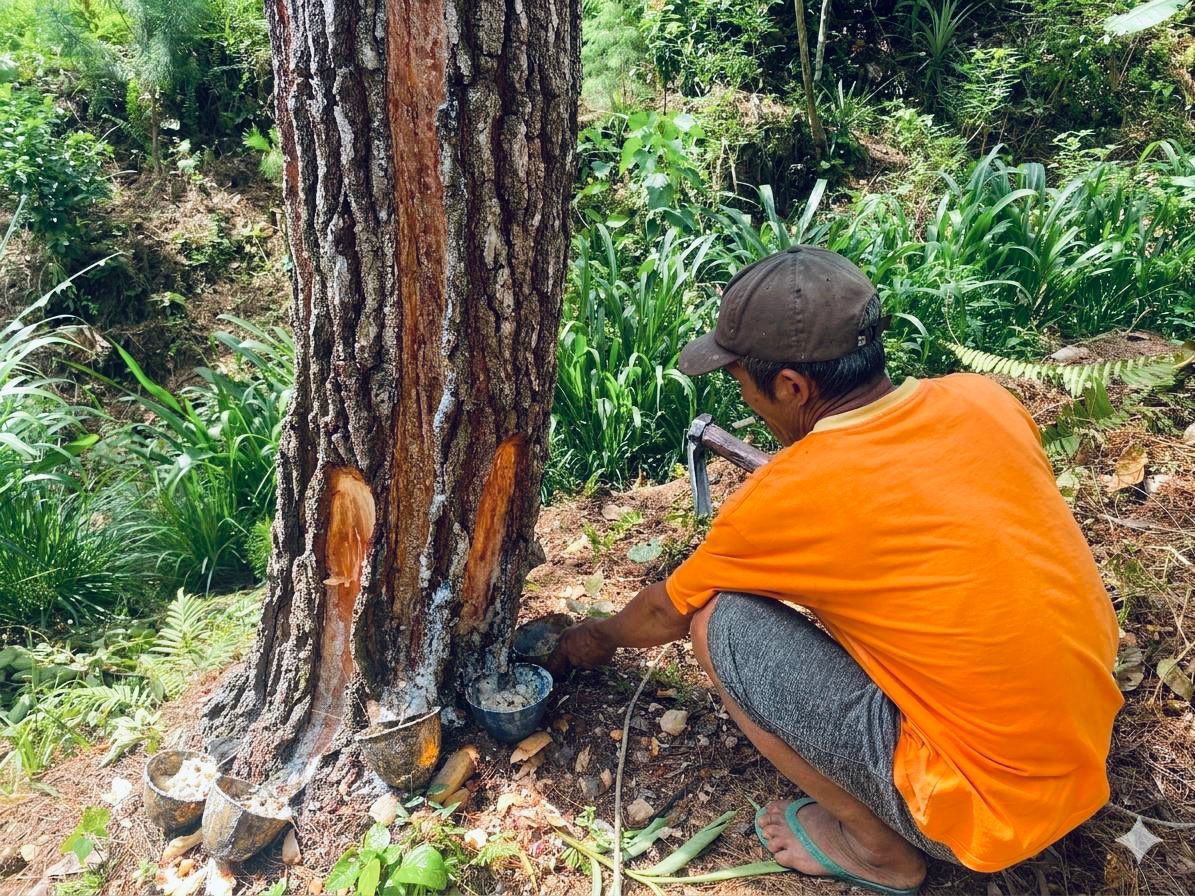
One of the non-timber forest products (NTFPs) widely managed and developed by communities surrounding forests is pine resin. Pine resin is a NTFP with high economic value and is widely used in various industries (Zakiyah et al., 2025). This resin is obtained through a tapping process on pine tree trunks. The resulting resin is then collected, collected, and further processed. In general, pine resin consists of two main components: gondorukem (solid resin) and turpentine (liquid resin), both of which have broad uses. Gondorukem is widely used in the paper, paint, adhesive, soap, printing ink, and cosmetics industries, while turpentine is used as a solvent, perfume mixture, and medicine. The pine resin tapping process requires proper techniques to avoid damaging the tree trunk and to ensure sustainable resin production.
Sustainable pine resin tapping is not only financially profitable but also helps preserve the environment. This activity encourages communities to refrain from indiscriminate tree felling, as the economic value of the resin is greater if the trees remain standing. Therefore, pine resin management is considered an example of environmentally friendly forest utilization practices, supporting the concept of sustainable development, while strengthening social and institutional aspects of the community (Moura et al., 2023) and (Oliveira et al., 2023).
Industrially, pine resin offers significant development opportunities in Indonesia, given the ever-increasing market demand, both domestically and internationally. Indonesia is one of the world's largest pine resin producers, thus offering significant potential to become a major player in the gondorukem and turpentine trade. However, realizing this potential requires improving production quality through the implementation of more modern tapping technologies, improving processing systems, and opening wider market access. If these aspects can be optimized, pine resin will become not only a local commodity but also a leading national commodity capable of increasing the country's foreign exchange (Tsioras, 2023).
Sasakan Village, Mamasa Regency, is one of the areas with the largest pine resin potential in West Sulawesi Province. In this village, the utilization of pine resin is an important alternative source of income for the village community. The pine forest area in this village is quite extensive, so the local community relies heavily on resin tapping as a supplementary livelihood besides farming. The collected pine resin is usually sold to collectors or processing industries, who then convert it into value-added products.
However, the sustainability of this business depends heavily on the efficiency of the supply chain. Although pine resin tapping technically adds value, the community often faces price uncertainty and unequal value distribution. Therefore, analyzing marketing margins and profit margins is crucial. Without a thorough understanding of these margins, it is difficult to determine whether the generated economic value is truly distributed fairly to tappers at the grassroots level or is instead trapped in the intermediary chain. This analysis is crucial for identifying market inefficiencies, optimizing real community incomes, and ensuring that economic incentives remain strong enough to motivate residents to maintain the long-term sustainability of the pine forests.
2. Materials and Method
1) Research Location
This research was conducted in Sasakan Village, Sumarorong Subdistrict, Mamasa Regency, West Sulawesi Province. The location was chosen based on the abundant potential of pine resin in this village, as it is one of the region's leading non-timber forest products. PT Kencana Hijau Bina Lestari in Polewali Mandar Regency is also a business operator in the pine resin industry.
2) Types and Sources of Data
The data collected in this study consists of primary and secondary data. Primary data was obtained from in-depth interviews with respondents, namely farmers who actively tap pine resin in Sasakan Village, interviews with partners, and joint interviews with PT KHBL (Kencana Hijau Bina Lestari). Primary data included prices and costs needed to calculate margin indicators. Meanwhile, secondary data was obtained from literature studies sourced from articles or other sources relevant to the research and also obtained from data available at relevant agencies. The secondary data collected included data on the general conditions of the research location and other necessary secondary data.
3) Sampling Technique
The population in this study was the community in Sasakan Village, Sumarorong Subdistrict, Mamasa Regency, West Sulawesi Province, which has pine trees. Total farmers actively tapping pine resin is 33 people, therefore census was used. The criteria for respondents used in this study were farmers who actively tapped pine resin and were involved in the pine resin business. In addition to farmers, this study also involved partners who collect pine resin from farmers, as well as representatives from PT KHBL (Kencana Hijau Bina Lestari).
4) Data Collection Techniques
Data collection techniques in this study were carried out in the following ways:
Field observation, which is a method carried out by collecting data through surveys or direct observation in the field.
Interviews, conducted by asking questions to respondents using the interview guide provided.
Literature study, which is data collection by collecting secondary data related to the study.
5) Data Analysis
The data analysis used in this study is quantitative analysis in the form of data obtained in the form of numbers that can be calculated, in this case the calculation of marketing margins and profit margins. The allocation of production costs is based on the proportion of output (yield) from the pine resin processing process, namely 75% producing gondorukem and 25% producing turpentine. This approach refers to the joint cost allocation method based on physical output, which is commonly used in the forestry product processing industry and agro-industry. The formula used in the margin calculation is as follows:
Marketing Margin
The margin calculation for each marketing agency uses the following formula (Su’udi, 2018):
Description:
Mp = Marketing Margin (IDR/kg)
Pr = Consumer prices (IDR/kg)
Pf = Price at producer level (IDR/kg)
Bp = Marketing costs (IDR/kg)
Kp = Profit (IDR/kg)
Profit Margin
The profit margin calculation for each business operator uses the following formula (Pratama, 2018):
Description:
Π = Profit Received by Each Actor
Pa = Selling price for each actor (IDR)
Pb = Purchase price of the product for each actor (IDR)
C = Marketing costs for each actor (IDR)
3. Result and Discussion
1) Marketing Channels
The marketing channel of pine resin in Sasakan Village illustrates the flow of products and value from upstream producers to downstream consumers, involving multiple actors with distinct roles in the supply chain. As shown in Figure 1, the marketing system consists of three main actors: farmers as primary producers, partners as intermediaries, and the processing industry (PT KHBL) as the downstream actor that transforms raw pine resin into higher-value products before reaching final consumers.
This structure reflects a typical value chain of non-timber forest products (NTFPs), where raw materials produced at the local level are gradually transferred through several stages of aggregation, processing, and distribution. The existence of multiple marketing channels indicates variations in the flow of products, which may influence both the efficiency of the supply chain and the distribution of economic benefits among actors. Understanding this marketing structure is essential for identifying how value is created and distributed along the chain, as well as for analyzing the differences in marketing margins and profit margins observed among actors in subsequent sections.
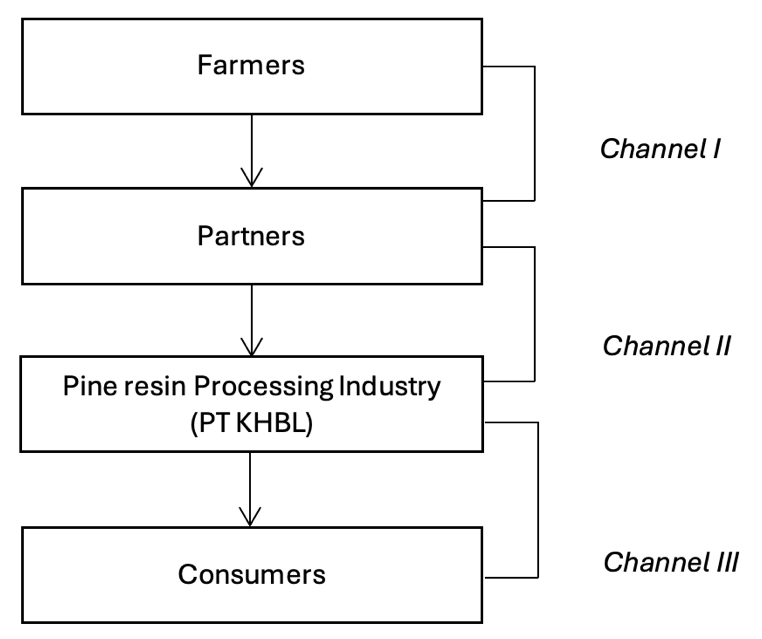
Figure 1. Pine resin Marketing Channel
2) Marketing Margin
Marketing margins indicate the difference between the selling price and the purchase price for each business actor (Cannon & Morgan, 2013). The results of the study indicate that the largest margin is at the third marketing channel level, namely the pine resin processing industry (PT KHBL), because it has processed pine resin into two types of final products, namely gondorukem and turpentine. The high marketing margin on an industrial scale is due to several factors, including the use of modern technology/equipment that can reduce raw material waste. PT KHBL processes on a large scale so that production costs per unit are lower, and not only processes but also secures direct supplies from pine resin tappers, in addition to the process also minimizes intermediaries.
The marketing margin of the final pine resin product in the form of gondorukem shows that in marketing channel I, the selling price at the farmer level is IDR 10,000/kg and is directly sold to partners. Marketing channel II shows the selling price to partners is IDR 12,000/kg and the partner's purchase price from farmers is IDR 10,000/kg so that the partner's marketing margin is IDR 2,000/kg. Marketing channel III shows the processing of pine resin into products and the price of gondorukem sold to consumers is IDR 25,000/kg so that the marketing margin is IDR 13,000/kg. The marketing margin data for gondorukem is presented in Table 1.
Table 1. Marketing Margin for Gondorukem Products

The marketing margin for the final pine resin product, turpentine, shows that in marketing channel I, the selling price at the farmer level remains at IDR 10,000/kg and is sold directly to partners. Marketing channel II shows that the selling price to partners then increases to IDR 12,000/kg, resulting in a partner marketing margin of IDR 2,000/kg. Marketing channel III shows that raw materials are processed into turpentine products, and the price of turpentine sold to consumers is IDR 75,000/kg, resulting in a marketing margin of IDR 63,000/kg. The turpentine marketing margin data is presented in Table 2.
Table 2. The turpentine marketing margin
3) Costs for Each Marketing Channel
To ensure consistency between aggregate costs and unit margin analysis, all costs presented in total (monthly or per production) are converted to a cost per kilogram by dividing the total cost by the total production volume (kg). This approach is used for all actors in the marketing chain, ensuring that marketing margin and profit margin calculations are comparable across actors.
Marketing Channel I (Farmers)
Based on field studies, in marketing channel I at the farmer level, no labor is involved in any of the pine resin processing processes, including tapping, pouring the resin into containers, or delivering it to partners. This is because each process is not particularly difficult and the amount of production produced in a single production run is inconsistent, meaning that whatever quantity of pine resin is collected, that amount is delivered to partners, thus eliminating the need for labor. Pine resin tapping farmers stated that family members usually assist them in each harvesting process, thus eliminating labor costs. This, of course, can help reduce costs during the pine resin harvesting process, which will affect profits (Khotimah et al., 2025).
Marketing Channel II (Partners)
The costs incurred in marketing channel II, namely Partners, are in the form of the cost of providing stimulants consisting of nitric acid at a price of IDR 21,000/kg, sulfuric acid IDR 27,000/kg and salt IDR 10,500/kg, then the cost of providing pine resin tapping equipment consisting of a resin bowl at a price of IDR 8,800/piece, a sap flow gutter IDR 250/piece, a hoe IDR 85,000/piece, a plastic sap container IDR 14,000/piece and a sap container sack IDR 1,300/piece, then the cost of transportation by partners to PT. KHBL Site Mamasa to store pine resin before being transported to PT. KHBL Site Polewali Mandar as a processing industry with a total transportation cost of IDR 1,500,000/month. So that the total cost incurred by partners is IDR 158,405,400. The total volume of pine resin marketed by partners is assumed to be equivalent to the raw material capacity received by the industry, which is 169,000 kg of pine resin per production cycle, resulting in a cost to partners of IDR 937/kg. Partner costs are presented in Table 3
Table 3. Partner Costs
Marketing Channel III (PT KHBL)
Marketing costs
The first cost incurred in marketing channel III, namely the pine resin processing industry, is the marketing cost of exporting gondorukem and turpentine to the domestic market and consumer countries by exporting seven containers each month. One shipment contains 109 tons of gondorukem and also 60 tons of turpentine, so in one shipment, PT KHBL incurs marketing costs through port agent services with a total of seven containers, amounting to IDR 139,200,000. The marketing costs incurred by PT KHBL are presented in Table 4.
Table 4. Wholesaler Marketing Costs
Equipment depreciation costs
The depreciation costs of equipment at PT KHBL are calculated using the straight-line method, namely by dividing the acquisition price of each piece of equipment by its economic life, so that the annual depreciation value is obtained which is then allocated to the production costs per cycle as presented in Table 5.
Labor Costs
PT KHBL's labor costs, which employ approximately 100 employees, are paid IDR 3,104,430 per month in Polewali Mandar Regency, resulting in total labor costs of IDR 310,443,000 per month.
Total Cost
The total cost incurred by PT KHBL, including marketing costs, equipment depreciation costs, and labor costs, is IDR 458,495,236. This total represents the aggregate cost for one production cycle that processes 169,000 kg of pine resin. For margin analysis purposes, this cost is converted to a cost per kilogram using the following calculation:
Based on the analysis, it is known that in a single production process of gondorukem and turpentine, which requires 169,000 kg of pine resin, the cost allocation was carried out using a physical output-based joint cost allocation approach, which produces 75% gondorukem namely 126,750 kg and 25% turpentine namely 42,250 kg in a single production run. Therefore, the cost per kg for each product is calculated as follows:
Cost of gondorukem per kg = (75% × total cost) / total gondorukem output
Cost of turpentine per kg = (25% × total cost) / total turpentine output
This approach allows for a clear link between aggregate production costs and the calculation of margins per unit. Therefore, the cost for each product, gondorukem and turpentine, is equal to IDR 2,712/kg.
4) Profit Margin
Profit margin represents the difference between the selling price and the purchase price, minus the total costs for each product sold (Silva, 2026). The study found that the largest profit margins were found at the third level of the marketing channel, namely wholesalers, in this case PT KHBL Site Polewali Mandar. This is due to their role as downstream players processing raw materials into high-value products, supported by production scale efficiencies, access to export markets, and a stronger bargaining position within the market structure. This situation results in the majority of added value in the pine resin supply chain being concentrated at the industrial level, which has marketed within the domestic market reach of Pasuruan City, Bekasi, and Bogor, as well as international markets including India, Japan, China, and Korea.
The profit margin for the final pine resin product, gondorukem, shows that in marketing channel I, the selling price to the farmer is IDR 10,000/kg, with no costs incurred, resulting in a profit margin of IDR 10,000/kg. Marketing channel II shows a selling price to partners of IDR 12,000/kg with costs incurred of IDR 937/kg so that the partner's profit margin is IDR 1,063/kg. Marketing channel III shows a selling price of gondorukem of IDR 25,000/kg with a total cost of IDR 2,712/kg so that the profit margin is IDR 10,288/kg. Gondorukem profit margin data is presented in Table 6.
Table 6. Gondorukem Product Profit Margin
The profit margin of the final product of pine resin in the form of turpentine shows that in marketing channel I, the selling price at the farmer level remains at IDR 10,000/kg and does not incur costs so that the farmer's profit margin is IDR 10,000/kg. Marketing channel II shows a selling price to partners of IDR 12,000/kg with costs incurred of IDR 937/kg so that the partner's profit margin is IDR 1,063/kg. Marketing channel III shows a turpentine selling price of IDR 75,000/kg with a total cost of IDR 2,712/kg so that the profit margin is IDR 60,288/kg. The turpentine profit margin data is presented in Table 7.
Table 7. Turpentine Product Profit Margin
4. Conclusion
This study demonstrates that the pine resin value chain in rural Indonesia is characterised by clear unequal value capture across actors. While farmers, partners, and the processing industry are structurally connected within the marketing system, the majority of economic value is concentrated at the downstream industrial level. This is particularly evident in the processing of turpentine, where both marketing and profit margins are substantially higher compared to upstream actors.
These findings indicate that unequal value capture is not merely a result of price differences, but reflects structural conditions within the value chain, including differences in processing capacity, access to technology, market reach, and bargaining power. As a result, upstream actors, particularly farmers, receive a relatively small share of the total economic benefits despite their central role in production.
This pattern highlights the presence of inefficiencies and imbalances in the pine resin marketing system, which may weaken long-term incentives for sustainable forest-based livelihoods. Addressing this issue requires strengthening farmer bargaining power, improving access to processing technologies at the local level, and promoting more inclusive market linkages. Enhancing equity in value capture is essential not only for improving rural incomes but also for supporting the sustainability of non-timber forest product-based systems.
5. Author Contributions
The first author contributed to the development of the research idea, formulation of the problem, development of the theoretical framework, collection of field data, and preparation of the initial draft of the article. The second author was responsible for collecting field data, data processing, financial ratio analysis, and preparation of the results and discussion sections up to the conclusion. Meanwhile, the third and fourth played a role in literature review, manuscript editing, and manuscript revision.
6. Competing Interests
The authors declare that there is no conflict of interest throughout the entire research process.
7. Acknowledgements
The authors would like to thank: (1) the Ministry of Higher Education, Science and Technology of the Republic of Indonesia for providing grant funding through the Early Career Researcher program, (2) the Faculty of Agriculture and Forestry, University of West Sulawesi, and (3) all authors who participated in the preparation of this article, (4) the community of Sasakan Village, Sumarorong Subdistrict, Mamasa Regency, West Sulawesi Province for their assistance and willingness to provide field data related to this research the partners, and (5) PT KHBL Mamasa and Polewali Mandar, for their support in collecting data related to this research.
8. References
Abate, H. Y., Aragie, S., & Desta, G. (2025). Non-Timber Forest Products and Their Income Contributions to Rural Households in Kalu District, Northeast Ethiopia. Journal of Landscape Ecology, 18(1), 25-40. https://doi.org/10.2478/jlecol-2025-0002
Adaaja, B. O., Akemien, N. N., Alawiye, M. A., Zaman, E. Y., Yahaya, U., & Khidir, H. Y. (2024). Economic and Ecological Sustainability of Non-Timber Forest Products (NTFPs) in Nigeria: A review. FUDMA Journal of Sciences, 8(6), 196-204. https://doi.org/10.33003/fjs-2024-0806-2909
Akomaning, Y. O., Darkwah, S. A., Živělová, I., & Hlaváčková, P. (2023). Achieving Sustainable Development Goals in Ghana: The Contribution of Non-Timber Forest Products towards Economic Development in the Eastern Region. Land, 12(3), 635. https://doi.org/10.3390/land12030635
Atinga, E., & Bannor, R. K. (2024). The Commercialisation of NTFPs and Conservation of Forest: A Systematic Review for Forestry Policy. Forestry Economics Review, 6(2), 94-121. https://doi.org/10.1108/FER-08-2023-0010
Beck, S., Harte, M., Goodrich, Z., & Ripin, R. (2023). Assessing the Sustainability of NTFP-Based Community Enterprises: A Viable Business Model for Indonesian Rural Forested Areas. Forests, 14(6). https://doi.org/10.3390/f14061251
Cannon, H. M., & Morgan, F. W. (2013). A strategic pricing framework. Journal of Business & Industrial Marketing, 6, 59–70. https://doi.org/10.1108/EUM0000000002756
Dako, F. X., Setyowati, R., Herningtyas, W., Pujiono, E., Budiman, I., Oskar Krisantus, & Paga, B. (2024). Development Strategy of Potential Non-Timber Forest Product Commodities in the Boti Indigenous Community, Indonesia. Jurnal Manajemen Hutan Tropika, 30(2), 246-257. https://doi.org/10.7226/246
Harbi, J., Cao, Y., Milantara, N., & Mustafa, A. B. (2023). Assessing the Sustainability of NTFP-Based Community Enterprises: A Viable Business Model for Indonesian Rural Forested Areas. Forests, 14(6). https://doi.org/10.3390/f14061251
Khotimah, K., Jumini, S., & Hannan, I. A. (2025). Analysis of Pine Sap Quality Based on Sieve Variations and its Effect on Economic Value. Jurnal Pendidikan MIPA. https://doi.org/10.37630/jpm.v15i4.3708
Mohale, Pradip, Rajesh Kumar, Gulendri Netam, Sandeep Chetan, Chetna Sahu, and Raman Choudhary. 2025. “Non-Timber Forest Products (NTFPs): Sustainable Harvesting and Utilization Practices”. Journal of Biology and Nature 17 (2):472-82. https://doi.org/10.56557/joban/2025/v17i29744.
Moura, M., Campelo, F., Nabais, C. Garcia-Forner, N. (2023). Resin tapping influence on maritime pine growth depends on tree age and stand characteristics. European Journal of Forest Research (142), 965–980. https://doi.org/10.1007/s10342-023-01568-7
Oliveira, R. A. F., Silva, R. A., & Martins, F. R. (2023). Resin Tapping Influence on Maritime Pine Growth Depends on Tree Age and Stand Characteristics. European Journal of Forest Research, 142(4), 965-980. https://doi.org/10.1007/s10342-023-01568-7
Pratama, A. G. (2018). Analisis rantai nilai (Value Chain Analysis) komoditi sutera di Kabupaten Wajo [Skripsi, Fakultas Kehutanan, Universitas Hasanuddin]. Universitas Hasanuddin Repository.
Su’udi, D. (2018). Saluran dan Marjin Pemasaran Gabah: Studi kasus di Kecamatan Balen Kabupaten Bojonegoro. Jurnal ORYZA, 4(1), 17–25.
Silva, E. A. (2026). Cost-Based Profits. SpringerBriefs in Economics, 1–4. https://doi.org/10.1007/978-3-032-11399-3_1
Tsioras, P. A., Giamouki, C., Tsaktsira, M., & Scaltsoyiannes, A. (2023). What the Fire Has Left Behind: Views and Perspectives of Resin Tappers in Central Greece. Sustainability, 15(12), 9777. https://doi.org/10.3390/su15129777
Zakiyah, A. M., Makkarennu, & Ridwan. (2025). Value Chain Analysis and Market Structure of Pine Resin Commodity in Community Forest Area Case in Indonesia. Perennial, 21(1). http://dx.doi.org/10.24259/perennial.v21i1.42890
Hak Cipta (c) 2026 Jurnal Wasian

This work is licensed under a Creative Commons Attribution 4.0 International License.
Artikel ini berlisensi Creative Commons Attribution 4.0 International License.
Copyright and License
All articles published in Wasian Journal are the property of the authors. By submitting an article to Wasian Journal, authors agree to the following terms:
-
Copyright Ownership: The author(s) retain copyright and full publishing rights without restrictions. Authors grant the journal the right to publish the work first and to distribute it as open access under a Creative Commons Attribution 4.0 International License (CC BY 4.0).
-
Licensing: Articles published in Wasian Journal are licensed under a Creative Commons Attribution 4.0 International License (CC BY 4.0). This license allows others to share, copy, and redistribute the material in any medium or format, and adapt, remix, transform, and build upon the material for any purpose, even commercially, provided that proper credit is given to the original author(s) and the source of the material

This work is licensed under a Creative Commons Attribution 4.0 International License. -
Author's Rights: Authors are permitted and encouraged to post their work online (e.g., in institutional repositories or on their website) prior to and during the submission process, as it can lead to productive exchanges and greater citation of published work.
-
Third-Party Content: If your article contains material (e.g., images, tables, or figures) for which you do not hold copyright, you must obtain permission from the copyright holder to use the material in your article. This permission must include the right for you to grant the journal the rights described above.
-
Reprints and Distribution: Authors have the right to distribute the final published version of their work (e.g., post it to an institutional repository or publish it in a book), provided that the original publication in Wasian Journal is acknowledged.
For the reader you are free to:
- Share — copy and redistribute the material in any medium or format for any purpose, even commercially.
- Adapt — remix, transform, and build upon the material for any purpose, even commercially.
- The licensor cannot revoke these freedoms as long as you follow the license terms.
Under the following terms:
- Attribution — You must give appropriate credit , provide a link to the license, and indicate if changes were made . You may do so in any reasonable manner, but not in any way that suggests the licensor endorses you or your use.
- No additional restrictions — You may not apply legal terms or technological measures that legally restrict others from doing anything the license permits.
Notices:
You do not have to comply with the license for elements of the material in the public domain or where your use is permitted by an applicable exception or limitation .
No warranties are given. The license may not give you all of the permissions necessary for your intended use. For example, other rights such as publicity, privacy, or moral rightsmay limit how you use the material.

Artikel paling banyak dibaca berdasarkan penulis yang sama
- Rini Pratiwi, Makkarennu Makkarennu, Ridwan Ridwan, Understanding Traditional Walnut Management System in Forest Communities of Selayar Islands, Indonesia , Jurnal Wasian: Vol 12 No 01 (2025): June
- Widyanti Utami A, Irlan Irlan, Nur Hilal A Syahrir, Rosmaeni Rosmaeni, Will Indonesia's Forests Survive Development Pressure? Machine Learning Predictions for Energy-Critical Tropical Watersheds , Jurnal Wasian: Vol 12 No 01 (2025): June