The Diversity of Macroscopic Fungi Species of The Wallacea in The Arboretum of BP2LHK Manado

Abstract
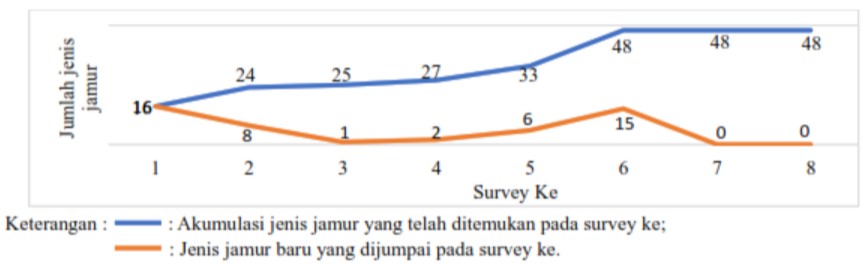
Fungi have a vital role in ecological processes, as an indicator of health of an ecosystem, it is not only has the potency for medicine and food but also variety of unexplored potential. Arboretum has high potential for biological conservation including fungi species, so information on its diversity and potency are very important for the basis of its management. The purpose of this research was to explore the diversity of species and the potential of macroscopic fungi in the BP2LHK Manado Arboretum. Observations were conducted 8 times in May, June, and September 2016 using a cruise and an opportunistic method. The infromation of growth media, light intensity, and temperature were collected as a supporting data. The result showed that arboretum stored 48 species of macroscopic fungi with different characteristics. 39 species were identified, divided into 2 divisions, 6 classes, 9 orders, and 17 families, while the remaining 9 species were unidentified.. The results showed that the diversity of macroscopic species habitat were dominated by 31 species grown on necromass, 11 species grown on litter and 6 species grown on soil. Based on its potential, there were 2 species of toxic fungi, 1 species of edible and medicinal fungus, 2 species of edible fungi, 5 species with medicinal fungi, 19 species were not edible, and 19 species with unknown benefits.
Copyright (c) 2018 Jurnal Wasian

This work is licensed under a Creative Commons Attribution-NonCommercial 4.0 International License.
Copyright and License
All articles published in Wasian Journal are the property of the authors. By submitting an article to Wasian Journal, authors agree to the following terms:
-
Copyright Ownership: The author(s) retain copyright and full publishing rights without restrictions. Authors grant the journal the right to publish the work first and to distribute it as open access under a Creative Commons Attribution 4.0 International License (CC BY 4.0).
-
Licensing: Articles published in Wasian Journal are licensed under a Creative Commons Attribution 4.0 International License (CC BY 4.0). This license allows others to share, copy, and redistribute the material in any medium or format, and adapt, remix, transform, and build upon the material for any purpose, even commercially, provided that proper credit is given to the original author(s) and the source of the material

This work is licensed under a Creative Commons Attribution 4.0 International License. -
Author's Rights: Authors are permitted and encouraged to post their work online (e.g., in institutional repositories or on their website) prior to and during the submission process, as it can lead to productive exchanges and greater citation of published work.
-
Third-Party Content: If your article contains material (e.g., images, tables, or figures) for which you do not hold copyright, you must obtain permission from the copyright holder to use the material in your article. This permission must include the right for you to grant the journal the rights described above.
-
Reprints and Distribution: Authors have the right to distribute the final published version of their work (e.g., post it to an institutional repository or publish it in a book), provided that the original publication in Wasian Journal is acknowledged.
For the reader you are free to:
- Share — copy and redistribute the material in any medium or format for any purpose, even commercially.
- Adapt — remix, transform, and build upon the material for any purpose, even commercially.
- The licensor cannot revoke these freedoms as long as you follow the license terms.
Under the following terms:
- Attribution — You must give appropriate credit , provide a link to the license, and indicate if changes were made . You may do so in any reasonable manner, but not in any way that suggests the licensor endorses you or your use.
- No additional restrictions — You may not apply legal terms or technological measures that legally restrict others from doing anything the license permits.
Notices:
You do not have to comply with the license for elements of the material in the public domain or where your use is permitted by an applicable exception or limitation .
No warranties are given. The license may not give you all of the permissions necessary for your intended use. For example, other rights such as publicity, privacy, or moral rightsmay limit how you use the material.
Similar Articles
- Ivan Permana Putra, The Potency of Some Wild Edible Mushrooms with Economic Value in Belitong Island, The Province of Bangka Belitung , Jurnal Wasian: Vol. 7 No. 2 (2020): December
- Muh Faisal Mappiasse, Andi Nurul Mukhlisa , Recognition and Analysis of Pest-Induced Damage in Mangrove Ecosystems: A Case Study in Maros Coastal Region , Jurnal Wasian: Vol. 11 No. 2 (2024): December
- Arif Irawan, Illa Anggraeni Anggraeni, Margaretta Christita, Identification Causes Leaf Spot Disease in Cempaka (Magnolia elegans (Blume.) H.Keng) Seedling and Its Control Techniques , Jurnal Wasian: Vol. 2 No. 2 (2015): December
- Elfrida Kastila Ine Tiga, Lusia Sulo Marimpan, Astin Elise Mau, Nixon Rammang, Assessing Agroforestry Impact on Household Income: A Study of the Bu’u Bei Community Forest (HKm) in Tina Bani Village, Ende, Indonesia , Jurnal Wasian: Vol. 11 No. 2 (2024): December
- Vivi Yuskianti, Miladiyah Hutami Saadi, Trikinasih Handayani, Diversity and Potential of Herb Vegetation in Forest Area With Special Purpose (KHDTK) Kaliurang Yogyakarta as Medicines , Jurnal Wasian: Vol. 6 No. 1 (2019): June
- Diah Irawati Dwi Arini, Yermias Kafiar, Prefered Feed of Anoa (Bubalus sp.) at Manado Forestry Research Institute Captivity , Jurnal Wasian: Vol. 1 No. 2 (2014): December
- Safinah Surya Hakim, Tri Wira Yuwati, Dony Rachmandi, Purwanto B Santosa, Dewi Alimah, Viability of Penicillium Citrinum on Different Carrier Media as Organic Fertilizer , Jurnal Wasian: Vol. 6 No. 2 (2019): December
- Andi Mawaddah Zakiyah, Rini Pratiwi, Astina Astina, Widyanti Utami A, Unequal Value Capture in Non-TimberForest Product Chains with Evidence fromPine Resin Processing in Rural Indonesia , Jurnal Wasian: Vol. 13 No. 01 (2026): June
- Heri Suryanto, Albert Donatus Mangopang , Planting of Nectar Plants as Feed of Butterflies Imago in Bantimurung Bulusaraung National Park , Jurnal Wasian: Vol. 10 No. 02 (2023): December
- Ni Putu Sri Asih, I Gusti Made Sudirga, I Gede - Tirta, The Diversity, Distribution and Conservation of Bali’s Medinilla in Eka Karya Bali Botanical Garden , Jurnal Wasian: Vol. 8 No. 2 (2021): December
You may also start an advanced similarity search for this article.
Most read articles by the same author(s)
- Margaretta Christita, Iwanuddin Iwanuddin, Yermias Kafiar, Supratman Tabba, Identification of Water Bacteria from Nickel Post Mining in East Halmahera , Jurnal Wasian: Vol. 5 No. 1 (2018): June
- Arif Irawan, Illa Anggraeni Anggraeni, Margaretta Christita, Identification Causes Leaf Spot Disease in Cempaka (Magnolia elegans (Blume.) H.Keng) Seedling and Its Control Techniques , Jurnal Wasian: Vol. 2 No. 2 (2015): December
- Ady Suryawan, Margaretta Christita, Endro Subiandono, Survival Rate, Growth and Seedling Quality Index of Baringtonia Asiatica Kurz Stump Due to Length Variation of Stems and Roots , Jurnal Wasian: Vol. 3 No. 2 (2016): December
- Margaretta Christita, Ady Suryawan, The Effectiveness of Papaya Leaves and Chili Pepper (Capsium fructescens) as Bioinsecticide for White Oyster Mushroom (Pleuroutus ostreatus) Cultivation , Jurnal Wasian: Vol. 5 No. 2 (2018): December
- Ady Suryawan, Effect of Media And Handling of Seed on Growth of Nyamplung (Calopyllum inophylum) Seedling , Jurnal Wasian: Vol. 1 No. 2 (2014): December