The Effectiveness of Private Forest Institutional and Policy in Banjarnegara and Banyumas Regency

Abstract
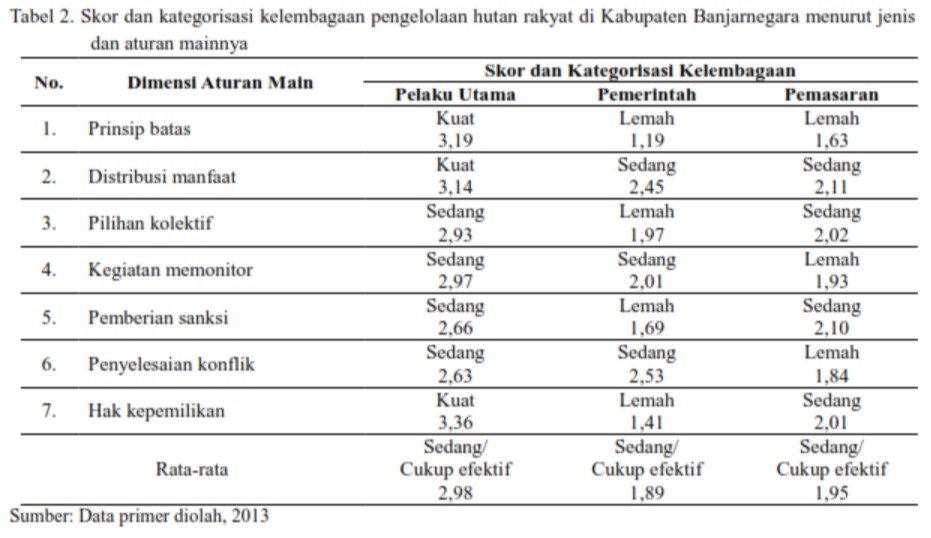
This research aimed to analyze the effectiveness of institusional and policy on private forest. The research was conducted in Banjarnegara and Banyumas Regency in August 2012 - May 2013. The methods used in this study are structured interview, open interview and Focus Group Discussion (FGD). Assessment of institutional effectiveness was done to government institutional, marketing institututional, and farmer institutional using recommended indicator namely: 1) user and resource boundaries, 2) appropriation and provision, 3) collective-choice arrangements, 4) monitoring, 5) graduated sanctions, 6) conflict-resolution mechanisms, and 7) recognition of appropriators’ rights to organize. The collected data were processed using likert scale and analyzed descriptively. The results showed that effectiveness of institutional in Kabupaten Banjarnegara and Banyumas Regency was moderate condition (quite effective). The effectiveness of private forest policy is seen from four policy viewpoints: policy accuracy, policy implementation, target accuracy, and environmental accuracy. Private forest policy in Kabupaten Banjarnegara is effective based on policy accuracy and environmental accuracy, while private forest policy in Banyumas Regency is effective based on target accuracy and environmental accuracy. This difference in assessment is due to the different of policy or program at the location according to the condition and the desire of community.
Copyright (c) 2017 Jurnal Wasian

This work is licensed under a Creative Commons Attribution-NonCommercial 4.0 International License.
Copyright and License
All articles published in Wasian Journal are the property of the authors. By submitting an article to Wasian Journal, authors agree to the following terms:
-
Copyright Ownership: The author(s) retain copyright and full publishing rights without restrictions. Authors grant the journal the right to publish the work first and to distribute it as open access under a Creative Commons Attribution 4.0 International License (CC BY 4.0).
-
Licensing: Articles published in Wasian Journal are licensed under a Creative Commons Attribution 4.0 International License (CC BY 4.0). This license allows others to share, copy, and redistribute the material in any medium or format, and adapt, remix, transform, and build upon the material for any purpose, even commercially, provided that proper credit is given to the original author(s) and the source of the material

This work is licensed under a Creative Commons Attribution 4.0 International License. -
Author's Rights: Authors are permitted and encouraged to post their work online (e.g., in institutional repositories or on their website) prior to and during the submission process, as it can lead to productive exchanges and greater citation of published work.
-
Third-Party Content: If your article contains material (e.g., images, tables, or figures) for which you do not hold copyright, you must obtain permission from the copyright holder to use the material in your article. This permission must include the right for you to grant the journal the rights described above.
-
Reprints and Distribution: Authors have the right to distribute the final published version of their work (e.g., post it to an institutional repository or publish it in a book), provided that the original publication in Wasian Journal is acknowledged.
For the reader you are free to:
- Share — copy and redistribute the material in any medium or format for any purpose, even commercially.
- Adapt — remix, transform, and build upon the material for any purpose, even commercially.
- The licensor cannot revoke these freedoms as long as you follow the license terms.
Under the following terms:
- Attribution — You must give appropriate credit , provide a link to the license, and indicate if changes were made . You may do so in any reasonable manner, but not in any way that suggests the licensor endorses you or your use.
- No additional restrictions — You may not apply legal terms or technological measures that legally restrict others from doing anything the license permits.
Notices:
You do not have to comply with the license for elements of the material in the public domain or where your use is permitted by an applicable exception or limitation .
No warranties are given. The license may not give you all of the permissions necessary for your intended use. For example, other rights such as publicity, privacy, or moral rightsmay limit how you use the material.
Similar Articles
- Yulianti Bramasto, Nurheni Wijayanto, Iskandar Z Siregar, I.G.K. Tapa Darma, The Variability of Seed Viability and Seed Vigour of Mindi (Melia azedarachlinn.) from Several Populations in The Community Forest of West Java , Jurnal Wasian: Vol. 3 No. 2 (2016): December
- Jauhar Mukti, Hikmah hikmah, Hendra Kurniawan, Ahmad Sabri, Budi Arty, Yuslan Demma Semu, Evaluating the Success of Watershed Rehabilitation Efforts in Gowa Regency: A Case Study on Forest and Land Restoration , Jurnal Wasian: Vol. 10 No. 02 (2023): December
- Agung Wahyu Nugroho, Heru Dwi Riyanto, Study of Light Intensity in Riparian Zone of Teak Production Forest in KHDTK Cemoro Modang , Jurnal Wasian: Vol. 7 No. 1 (2020): June
- relawan kuswandi, Julius Dwi Nugroho, Diameter Increment of Remnant Stands in Logged-Over Forest in Papua , Jurnal Wasian: Vol. 6 No. 2 (2019): December
- Iskandar Z Siregar, Riki Ramdhani, Evayusvita Rustam, Dede J Sudrajat, The Effect of Invigoration Using Polyethylene Glycol And Ultra Fine Bubble on Improving of Sengon Seeds (Falcataria Moluccana Miq.) Quality After Two Years Storage , Jurnal Wasian: Vol. 8 No. 2 (2021): December
- Andes Hamuraby Rozak, Destri Destri, Zaenal Mutaqien, Tree Biomass Estimation in Karst Forest of West Papua, Indonesia , Jurnal Wasian: Vol. 8 No. 2 (2021): December
- Wahyuni, The Utilization of ALOS PALSAR Image to Estimate Natural Forest Biomass: Case Study at Bogani Nani Wartabone National Park (Pemanfaatan Citra ALOS PALSAR dalam Menduga Biomasa Hutan Alam: Studi Kasus di Taman Nasional Bogani Nani Wartabone) , Jurnal Wasian: Vol. 1 No. 1 (2014): June
- Margaretta Christita, Ady Suryawan, The Effectiveness of Papaya Leaves and Chili Pepper (Capsium fructescens) as Bioinsecticide for White Oyster Mushroom (Pleuroutus ostreatus) Cultivation , Jurnal Wasian: Vol. 5 No. 2 (2018): December
- Vina Fitriana, Rujito Agus Suwignyo, Siti Fauziyah, The Changes in Vast Mangrove Area of Pantai Air Telang Protected Forest Banyuasin District using Landsat Imagery Data Time Series , Jurnal Wasian: Vol. 4 No. 2 (2017): December
- Tri Sayektiningsih, Amir Ma’ruf , Vegetation Characteristics of the Orangutan (Pongo pygmaeus morio) Habitat in the Riparian Forest of Menamang, East Kalimantan , Jurnal Wasian: Vol. 4 No. 1 (2017): June
You may also start an advanced similarity search for this article.
Most read articles by the same author(s)
- Tri Sulistyati Widyaningsih, Eva Fauziyah, Devy Priambodo Kuswantoro, Processing and Added Value of Bamboo in Tasikmalaya, West Java , Jurnal Wasian: Vol. 7 No. 1 (2020): June
- Maria Palmolina, Eva Fauziyah, Conflict Mapping of Gunung Ciremai National Park in Cisantana Village, Cigugur, Kuningan, West Java , Jurnal Wasian: Vol. 7 No. 2 (2020): December