The Potency of Some Wild Edible Mushrooms with Economic Value in Belitong Island, The Province of Bangka Belitung

Abstract
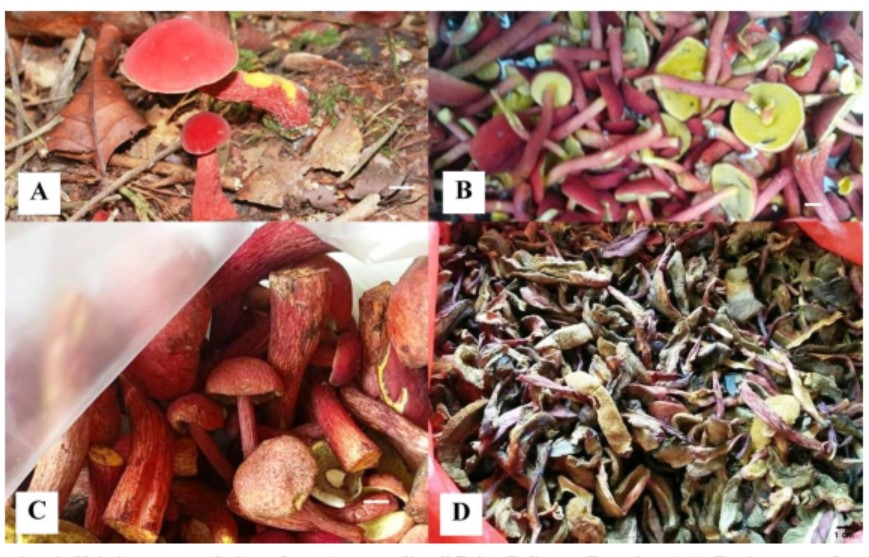
Belitong Island, The Province of Bangka Belitung is one of the exotic places with the biodiversity which has not been optimally inventoried. One of the potential germplasm that has not been recorded properly on Belitong Island is the mushrooms diversity and their potential uses. Mushroom are known as non-timber forestry product that is often sought after by local ethnic of Belitong Island and used as food. Apart from being consumed, these wild mushrooms are also traded, so they are one of the important seasonal commodities for the local community. This research aimed to provide the basic taxonomical information of wild edible mushroom in Belitong island as well as the biological characters. Observations were conducted 2 times in 2018 – 2019 using opportunistic sampling method. The utilization data of wild edible mushroom were collected to complete the macrofungi description in this study. A number of 5 edible wild mushrooms with th economic value reported in this study were: Amanita sect. caesarea (kulat pelandok), Heimioporus sp. (kulat pelawan), Hygrocybe cf. conica (kulat tiong), Phylloporus sp. (kulat sukatan) and Volvariella sp. (kulat sawit). Three species of fungi are ectomycorrhizal forming fungi, namely kulat pelandok with Schima wallichii, kulat pelawan with Tristaniopsis merguensis, and kulat sukatan which host is still unclear. Meanwhile the rest are saprophytic macrofungi. All wild edible mushrooms are members of the phylum Basidiomycota which are divided into 2 orders and 4 families. Heimioporus sp. is known to be the highest selling price mushroom compared to the others, which indicated the potential prospect to proceed to the cultivation stage. In addition, conservation management of plants that are hosts of ectomycorrhizal fungi need to be an important concern on Belitong Island.
Copyright (c) 2020 Jurnal Wasian

This work is licensed under a Creative Commons Attribution-NonCommercial 4.0 International License.
Copyright and License
All articles published in Wasian Journal are the property of the authors. By submitting an article to Wasian Journal, authors agree to the following terms:
-
Copyright Ownership: The author(s) retain copyright and full publishing rights without restrictions. Authors grant the journal the right to publish the work first and to distribute it as open access under a Creative Commons Attribution 4.0 International License (CC BY 4.0).
-
Licensing: Articles published in Wasian Journal are licensed under a Creative Commons Attribution 4.0 International License (CC BY 4.0). This license allows others to share, copy, and redistribute the material in any medium or format, and adapt, remix, transform, and build upon the material for any purpose, even commercially, provided that proper credit is given to the original author(s) and the source of the material

This work is licensed under a Creative Commons Attribution 4.0 International License. -
Author's Rights: Authors are permitted and encouraged to post their work online (e.g., in institutional repositories or on their website) prior to and during the submission process, as it can lead to productive exchanges and greater citation of published work.
-
Third-Party Content: If your article contains material (e.g., images, tables, or figures) for which you do not hold copyright, you must obtain permission from the copyright holder to use the material in your article. This permission must include the right for you to grant the journal the rights described above.
-
Reprints and Distribution: Authors have the right to distribute the final published version of their work (e.g., post it to an institutional repository or publish it in a book), provided that the original publication in Wasian Journal is acknowledged.
For the reader you are free to:
- Share — copy and redistribute the material in any medium or format for any purpose, even commercially.
- Adapt — remix, transform, and build upon the material for any purpose, even commercially.
- The licensor cannot revoke these freedoms as long as you follow the license terms.
Under the following terms:
- Attribution — You must give appropriate credit , provide a link to the license, and indicate if changes were made . You may do so in any reasonable manner, but not in any way that suggests the licensor endorses you or your use.
- No additional restrictions — You may not apply legal terms or technological measures that legally restrict others from doing anything the license permits.
Notices:
You do not have to comply with the license for elements of the material in the public domain or where your use is permitted by an applicable exception or limitation .
No warranties are given. The license may not give you all of the permissions necessary for your intended use. For example, other rights such as publicity, privacy, or moral rightsmay limit how you use the material.
Similar Articles
- Nisa Nur Ramadhani , Wahyuni, Putri Fatimah Nurdin, Muhammad Daud, Spatiotemporal Land Cover Dynamics and Their Implications For Watershed Quality in the Minraleng Sub-Watershed, Indonesia , Jurnal Wasian: Vol. 13 No. 01 (2026): June
- I Wayan Sudiyanto, Wahyudi Wahyudi, Assessment and Spatial Mapping of Soil Degradation Status in Bontoharu District, Selayar Islands Regency: A Framework for Sustainable Land Management , Jurnal Wasian: Vol. 12 No. 01 (2025): June
- Muh Faisal Mappiasse, Andi Nurul Mukhlisa , Recognition and Analysis of Pest-Induced Damage in Mangrove Ecosystems: A Case Study in Maros Coastal Region , Jurnal Wasian: Vol. 11 No. 2 (2024): December
- Aditya Hani, Eva Fauziyah, Tri Sulistyawati Widyaningsih, Devy Priambodo Kuswantoro, Potency and Agroforestry Patterns that Support Bamboo Sustainability in Sukaharja Village, Ciamis District , Jurnal Wasian: Vol. 5 No. 2 (2018): December
- Lusiana Pardede, Dian Iswandaru, Yulia Rahma Fitriana, Arief Darmawan, Hari Kaskoyo, Christine Wulandari, Rahmat Safe'I, Susni Herwanti, Novriyanti, Indra Gumay Febryano, Insectivorous Birds Dominate Across Land-Use Gradient Revealing Unexpected Ecological Resilience in Tropical Forest-Coffee Landscapes , Jurnal Wasian: Vol. 12 No. 01 (2025): June
- Agustina Sumarni Ciputri Blolok, Wilhelmina Seran, Astin Elise Mau, Muhamad Soimin, Optimising Growing Media Composition and Seed Selection Strategies For the Conversation of the Endangered Sandalwood (Santalum album Linn.) , Jurnal Wasian: Vol. 11 No. 2 (2024): December
- Dyah Arum Kusumaningsih, Kanti Suraningsih, Dwi Sri Nuryanti, Arif Irawan, Marciano Borges Ximenes, Indah Susilowati, Study of Economic Value of Water for Domestic and Agricultural Uses in Grojogan Sewu Nature Tourism Parkwater Conservation , Jurnal Wasian: Vol. 9 No. 1 (2022): June
- Baharinawati Wilhan Hastanti, Freddy Jontara Hutapea, Analysis of Vulnerability Levels to the Flash Flood Based on Social Economic and Institutional Factors in Wasior, Teluk Wondama, West Papua , Jurnal Wasian: Vol. 7 No. 1 (2020): June
- Roslina Yahya, Dr. Hadija Sukri, S.P.,M.P, Dr.Ir. Nirawati., S.Hut.,M.hut.,IPP, Dr. Ira Nurhayati Djarot, Responses of Stomatal Characteristics to Environmental Factors in Fabaceae Trees of the Urban Forest in Maros Regency , Jurnal Wasian: Vol. 12 No. 01 (2025): June
- Wahyudi Isnan, Nurhaedah Muin, Nur Hayati, Perception and Motivation of Farmers in the Development of Natural Silk Business in Soppeng Regency Sulawesi Selatan , Jurnal Wasian: Vol. 6 No. 1 (2019): June
You may also start an advanced similarity search for this article.