The Diversity, Distribution and Conservation of Bali’s Medinilla in Eka Karya Bali Botanical Garden

Abstract
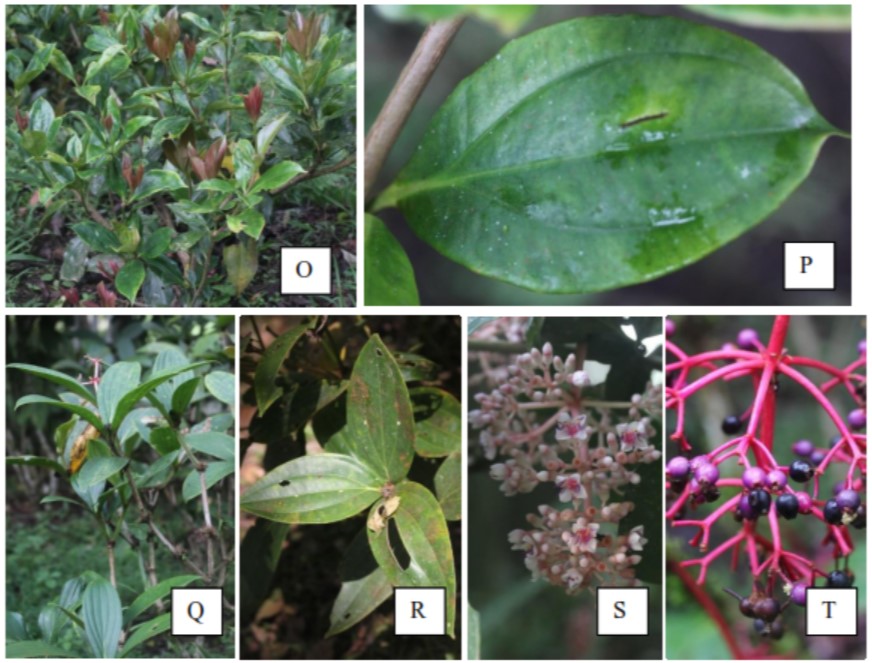
Medinilla is a tropical forest plant that has potential as an ornamental and medicinal plant. The diversity of medinilla in Bali is poorly studied. This study aims to determine the diversity, distribution and conservation activities of Bali’s medinilla at the Eka Karya Bali Botanical Garden. An observational study, documentation and literature were used in this research. Based on this research, it is known that there are six species of medinilla in Bali such as Medinilla crassifolia (Reinw.ex Blume) Blume, Medinilla alpestris Blume, Medinilla laurifolia (Blume) Blume, Medinilla radicans (Blume) Blume, Medinilla speciosa (Reinw.ex Blume) Blume and Medinilla quadrifolia (BI.) Bakh. F. M. quadrifolia is a new distribution record for Bali. All species were discovered in the districts of Buleleng, Bangli, Gianyar, Jembrana, Karangasem and Tabanan districts. Only four species have been conserved in the Bali Botanical Gardens, according to data from the Eka Karya Bali Botanical Gardens' collection, therefore exploration and collection activities are critical. Conservation activities carried out at Eka Karya Bali Botanical Garden are collecting and data collection, maintaining and propagating species of medinilla.
Copyright (c) 2021 Jurnal Wasian

This work is licensed under a Creative Commons Attribution-NonCommercial 4.0 International License.
Copyright and License
All articles published in Wasian Journal are the property of the authors. By submitting an article to Wasian Journal, authors agree to the following terms:
-
Copyright Ownership: The author(s) retain copyright and full publishing rights without restrictions. Authors grant the journal the right to publish the work first and to distribute it as open access under a Creative Commons Attribution 4.0 International License (CC BY 4.0).
-
Licensing: Articles published in Wasian Journal are licensed under a Creative Commons Attribution 4.0 International License (CC BY 4.0). This license allows others to share, copy, and redistribute the material in any medium or format, and adapt, remix, transform, and build upon the material for any purpose, even commercially, provided that proper credit is given to the original author(s) and the source of the material

This work is licensed under a Creative Commons Attribution 4.0 International License. -
Author's Rights: Authors are permitted and encouraged to post their work online (e.g., in institutional repositories or on their website) prior to and during the submission process, as it can lead to productive exchanges and greater citation of published work.
-
Third-Party Content: If your article contains material (e.g., images, tables, or figures) for which you do not hold copyright, you must obtain permission from the copyright holder to use the material in your article. This permission must include the right for you to grant the journal the rights described above.
-
Reprints and Distribution: Authors have the right to distribute the final published version of their work (e.g., post it to an institutional repository or publish it in a book), provided that the original publication in Wasian Journal is acknowledged.
For the reader you are free to:
- Share — copy and redistribute the material in any medium or format for any purpose, even commercially.
- Adapt — remix, transform, and build upon the material for any purpose, even commercially.
- The licensor cannot revoke these freedoms as long as you follow the license terms.
Under the following terms:
- Attribution — You must give appropriate credit , provide a link to the license, and indicate if changes were made . You may do so in any reasonable manner, but not in any way that suggests the licensor endorses you or your use.
- No additional restrictions — You may not apply legal terms or technological measures that legally restrict others from doing anything the license permits.
Notices:
You do not have to comply with the license for elements of the material in the public domain or where your use is permitted by an applicable exception or limitation .
No warranties are given. The license may not give you all of the permissions necessary for your intended use. For example, other rights such as publicity, privacy, or moral rightsmay limit how you use the material.
Similar Articles
- Agung Wahyu Nugroho, Heru Dwi Riyanto, Study of Light Intensity in Riparian Zone of Teak Production Forest in KHDTK Cemoro Modang , Jurnal Wasian: Vol. 7 No. 1 (2020): June
- Baharinawati Wilhan Hastanti, Freddy Jontara Hutapea, Analysis of Vulnerability Levels to the Flash Flood Based on Social Economic and Institutional Factors in Wasior, Teluk Wondama, West Papua , Jurnal Wasian: Vol. 7 No. 1 (2020): June
- Baharinawati Wilhan Hastanti, S. Agung Sri Raharjo, Stakeholder Analysis of Implementation of Social Forestry Program at KPH Telawa, Central Java , Jurnal Wasian: Vol. 8 No. 1 (2021): June
- Ulfah Karmila Sari, Bina Swasta Sitepu, Mukhlisi Mukhlisi, Puji Mulyanto, Floristic Composition and Soil Characteristics in Muara Kaman Sedulang Nature Reserve, East Kalimantan , Jurnal Wasian: Vol. 8 No. 1 (2021): June
- Iskandar Z Siregar, Riki Ramdhani, Evayusvita Rustam, Dede J Sudrajat, The Effect of Invigoration Using Polyethylene Glycol And Ultra Fine Bubble on Improving of Sengon Seeds (Falcataria Moluccana Miq.) Quality After Two Years Storage , Jurnal Wasian: Vol. 8 No. 2 (2021): December
- Golar Golar, Hasriani Muis, Wahyu Syahputra Simorangkir, Conflict Variety and the Facilitation Role of Forest Managemen Unit (FMU) on Resolution of Tenurial Conflict , Jurnal Wasian: Vol. 9 No. 1 (2022): June
- Rubangi Al Hasan, Krisnawati Krisnawati, Anita AD Rahayu, Preservation Efforts of Pranajiwa (Euchresta horsfieldii (Lesch.) Benn.) Based on Tri Hita Karana by Balinese Community , Jurnal Wasian: Vol. 9 No. 1 (2022): June
You may also start an advanced similarity search for this article.