Analysis of Vulnerability Levels to the Flash Flood Based on Social Economic and Institutional Factors in Wasior, Teluk Wondama, West Papua

Abstract
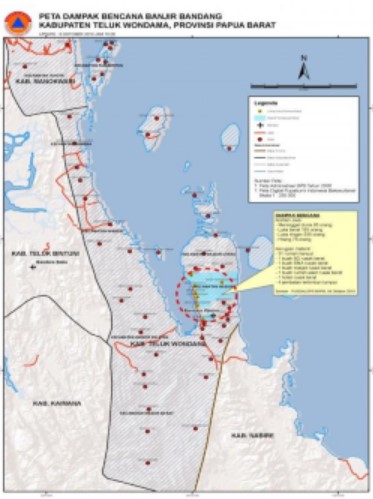
One form of disaster mitigation is to know the vulnerability of areas that are at risk of disaster socially and economically. Studies on vulnerability to flash floods are necessary, as it might prevent material losses and fatalities. Wasior District at Teluk Wondama Regency experienced a flash flood in 2010 causing negative impacts such as fatalities and large material losses. To anticipate flash floods that might occur in the future, studies to evaluate the vulnerability to the flash flood are needed. This study aimed to: 1) analyze the level of vulnerability to flash floods in Wasior based on socioeconomic factors post the 2010 flash floods, 2) analyze the level of vulnerability to flash floods in Wasior based on institutional factors. The method used in this study was a combination of qualitative and quantitative methods. Data collection was conducted by observation, interview, and documentation. Data were analyzed by: 1) identifying the socioeconomic indicators of the community and institutions around the watershed, 2) providing weighting scores to the social economic criteria and institutional criteria from the most vulnerable to the least vulnerable, 3) assessing the level of community and institution vulnerabilities in the study site to the impact of flash floods based on the calculation of the weighting scores of socio-economic and institutional indicators. The results showed that the level of socioeconomic vulnerability to flash floods were categorized as moderate (total score 2.084), while the level of institutional vulnerability was low (total score 2.251). The results of this study can be used as a basis for considerations in the implementation of flash flood mitigation in Wasior.
Copyright (c) 2020 Jurnal Wasian

This work is licensed under a Creative Commons Attribution-NonCommercial 4.0 International License.
Copyright and License
All articles published in Wasian Journal are the property of the authors. By submitting an article to Wasian Journal, authors agree to the following terms:
-
Copyright Ownership: The author(s) retain copyright and full publishing rights without restrictions. Authors grant the journal the right to publish the work first and to distribute it as open access under a Creative Commons Attribution 4.0 International License (CC BY 4.0).
-
Licensing: Articles published in Wasian Journal are licensed under a Creative Commons Attribution 4.0 International License (CC BY 4.0). This license allows others to share, copy, and redistribute the material in any medium or format, and adapt, remix, transform, and build upon the material for any purpose, even commercially, provided that proper credit is given to the original author(s) and the source of the material

This work is licensed under a Creative Commons Attribution 4.0 International License. -
Author's Rights: Authors are permitted and encouraged to post their work online (e.g., in institutional repositories or on their website) prior to and during the submission process, as it can lead to productive exchanges and greater citation of published work.
-
Third-Party Content: If your article contains material (e.g., images, tables, or figures) for which you do not hold copyright, you must obtain permission from the copyright holder to use the material in your article. This permission must include the right for you to grant the journal the rights described above.
-
Reprints and Distribution: Authors have the right to distribute the final published version of their work (e.g., post it to an institutional repository or publish it in a book), provided that the original publication in Wasian Journal is acknowledged.
For the reader you are free to:
- Share — copy and redistribute the material in any medium or format for any purpose, even commercially.
- Adapt — remix, transform, and build upon the material for any purpose, even commercially.
- The licensor cannot revoke these freedoms as long as you follow the license terms.
Under the following terms:
- Attribution — You must give appropriate credit , provide a link to the license, and indicate if changes were made . You may do so in any reasonable manner, but not in any way that suggests the licensor endorses you or your use.
- No additional restrictions — You may not apply legal terms or technological measures that legally restrict others from doing anything the license permits.
Notices:
You do not have to comply with the license for elements of the material in the public domain or where your use is permitted by an applicable exception or limitation .
No warranties are given. The license may not give you all of the permissions necessary for your intended use. For example, other rights such as publicity, privacy, or moral rightsmay limit how you use the material.
Similar Articles
- Baharinawati Wilhan Hastanti, S. Agung Sri Raharjo, Stakeholder Analysis of Implementation of Social Forestry Program at KPH Telawa, Central Java , Jurnal Wasian: Vol. 8 No. 1 (2021): June
- Bertila Avila Delvion, Dwiko Budi Permadi, Hero Marhaento, Fostering Sustainabel Livelihood of the Saga Indigenous Community through Conservation Partnership in Kelimutu National Park, Nusa Tenggara Timur , Jurnal Wasian: Vol. 10 No. 02 (2023): December
- Wahyudi Isnan, Nurhaedah Muin, Nur Hayati, Perception and Motivation of Farmers in the Development of Natural Silk Business in Soppeng Regency Sulawesi Selatan , Jurnal Wasian: Vol. 6 No. 1 (2019): June
- Golar Golar, Hasriani Muis, Wahyu Syahputra Simorangkir, Conflict Variety and the Facilitation Role of Forest Managemen Unit (FMU) on Resolution of Tenurial Conflict , Jurnal Wasian: Vol. 9 No. 1 (2022): June
- Ivan Permana Putra, The Potency of Some Wild Edible Mushrooms with Economic Value in Belitong Island, The Province of Bangka Belitung , Jurnal Wasian: Vol. 7 No. 2 (2020): December
- Aditya Hani, Eva Fauziyah, Tri Sulistyawati Widyaningsih, Devy Priambodo Kuswantoro, Potency and Agroforestry Patterns that Support Bamboo Sustainability in Sukaharja Village, Ciamis District , Jurnal Wasian: Vol. 5 No. 2 (2018): December
- Lis Nurrani, M Bismark, Supratman Tabba, Institution and Communities Participation in the Conservation Of Mangrove/Case Study in Tiwoho Village, North Province , Jurnal Wasian: Vol. 2 No. 1 (2015): March
- Roslina Yahya, Dr. Hadija Sukri, S.P.,M.P, Dr.Ir. Nirawati., S.Hut.,M.hut.,IPP, Dr. Ira Nurhayati Djarot, Responses of Stomatal Characteristics to Environmental Factors in Fabaceae Trees of the Urban Forest in Maros Regency , Jurnal Wasian: Vol. 12 No. 01 (2025): June
- Maria Palmolina, Eva Fauziyah, Conflict Mapping of Gunung Ciremai National Park in Cisantana Village, Cigugur, Kuningan, West Java , Jurnal Wasian: Vol. 7 No. 2 (2020): December
- Naning Yuniarti, The Invigoration Techniques of Nyamplung (Calophyllum inophyllum L.) Seeds During the Storage , Jurnal Wasian: Vol. 7 No. 1 (2020): June
You may also start an advanced similarity search for this article.
Most read articles by the same author(s)
- Baharinawati Wilhan Hastanti, S. Agung Sri Raharjo, Stakeholder Analysis of Implementation of Social Forestry Program at KPH Telawa, Central Java , Jurnal Wasian: Vol. 8 No. 1 (2021): June
- Baharinawati Wilhan Hastanti, Relawan Kuswandi, Julanda Noya, Development Strategy of Masoi (Cryptocarya massoia (Oken) Kosterm.) as Non-Timber Forest Products in Teluk Bintuni, West Papua With SWOT Analysis , Jurnal Wasian: Vol. 5 No. 1 (2018): June
- Freddy Jontara Hutapea, Relawan Kuswandi, Timber Volume Estimation Model for Commercial Tree Species in the Logging Area Concession of PT. Tunas Timber Lestari in Boven Digul, Papua , Jurnal Wasian: Vol. 6 No. 1 (2019): June