Identification and Seedlings Growth Evaluation of Shorea Species-Producing Tengkawang

Abstract
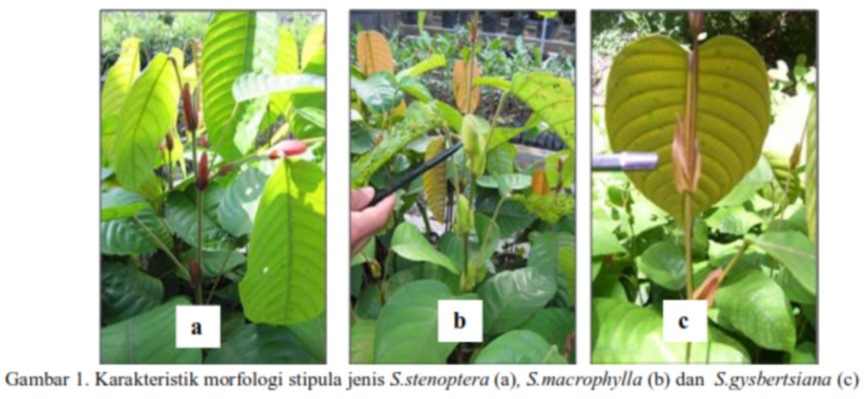
Most of non timber forest product (NTFP) utilization taken from natural forests which decrease on productivity annually, including tengkawang producer species which taken from West Kalimantan natural forests. This condition needs an effort to preserve those species from natural population utilization through plantation forest development that require spesific strategy. This study was part of breeding strategy of shorea species producing tengkawang which aimed to species identify and seedling growth evaluation used genetic material from 2 (two) population from West Kalimantan. The research was arranged in 2 (two) steps, i.e.1) species identification used morphology characteristic difference, and 2) seedling growth evaluation (height,diameter,sturdiness). Seedling growth evaluation was arranged in RCBD, with 5 plot (combination of species and source population), contained 25 seedlings and 4 replications (blocks). The result showed that seedlings of shorea species producing tengkawang, i.e. S.stenoptera, S.macrophylla, and S.gysbertsiana can be different from its stipulae morphology characteristic. Growth of 10 months shorea species producing tengkawang seedlings were significantly different on height and sturdiness. Seedlings height were 67,19 – 88,79 cm, seedlings diameter 9,65 – 10,33 mm and sturdiness 7 – 9,21 in range. The best seedling growth was S.stenoptera and S.macrophylla from Gunung Bunga, West Kalimantan.
Copyright (c) 2015 Jurnal Wasian

This work is licensed under a Creative Commons Attribution-NonCommercial 4.0 International License.
Copyright and License
All articles published in Wasian Journal are the property of the authors. By submitting an article to Wasian Journal, authors agree to the following terms:
-
Copyright Ownership: The author(s) retain copyright and full publishing rights without restrictions. Authors grant the journal the right to publish the work first and to distribute it as open access under a Creative Commons Attribution 4.0 International License (CC BY 4.0).
-
Licensing: Articles published in Wasian Journal are licensed under a Creative Commons Attribution 4.0 International License (CC BY 4.0). This license allows others to share, copy, and redistribute the material in any medium or format, and adapt, remix, transform, and build upon the material for any purpose, even commercially, provided that proper credit is given to the original author(s) and the source of the material

This work is licensed under a Creative Commons Attribution 4.0 International License. -
Author's Rights: Authors are permitted and encouraged to post their work online (e.g., in institutional repositories or on their website) prior to and during the submission process, as it can lead to productive exchanges and greater citation of published work.
-
Third-Party Content: If your article contains material (e.g., images, tables, or figures) for which you do not hold copyright, you must obtain permission from the copyright holder to use the material in your article. This permission must include the right for you to grant the journal the rights described above.
-
Reprints and Distribution: Authors have the right to distribute the final published version of their work (e.g., post it to an institutional repository or publish it in a book), provided that the original publication in Wasian Journal is acknowledged.
For the reader you are free to:
- Share — copy and redistribute the material in any medium or format for any purpose, even commercially.
- Adapt — remix, transform, and build upon the material for any purpose, even commercially.
- The licensor cannot revoke these freedoms as long as you follow the license terms.
Under the following terms:
- Attribution — You must give appropriate credit , provide a link to the license, and indicate if changes were made . You may do so in any reasonable manner, but not in any way that suggests the licensor endorses you or your use.
- No additional restrictions — You may not apply legal terms or technological measures that legally restrict others from doing anything the license permits.
Notices:
You do not have to comply with the license for elements of the material in the public domain or where your use is permitted by an applicable exception or limitation .
No warranties are given. The license may not give you all of the permissions necessary for your intended use. For example, other rights such as publicity, privacy, or moral rightsmay limit how you use the material.
Similar Articles
- Fajar Lestari, Beny Rahmanto, The Plants Extract Toxicity Againts Achatina fulica (Ferussac, 1821) in Nyawai Ficus variegata (Blume) , Jurnal Wasian: Vol. 7 No. 1 (2020): June
- Naning Yuniarti, The Invigoration Techniques of Nyamplung (Calophyllum inophyllum L.) Seeds During the Storage , Jurnal Wasian: Vol. 7 No. 1 (2020): June
- Nur Reski, Rahmat Ariandi, Hajawa Hajawa, Hasanuddin Hasanuddin, Sultan Sultan, Andi Azis Abdullah, Gender Roles in Coffee Agroforestry Management: A Case Study of the Boritallasa Community Forestry Area, Gowa Regency, Indonesia , Jurnal Wasian: Vol. 13 No. 01 (2026): June
- Sudiyono Sudiyono, Evaluation of Vegetation and Wildlife in Gunung Ambang Nature Reserve , Jurnal Wasian: Vol. 1 No. 2 (2014): December
- Aditya Hani, Levina Pieter Geraldine , The Effect of Three Spacing and Goat Urine Application on Early Growth of Manglid , Jurnal Wasian: Vol. 3 No. 2 (2016): December
- Yulianti Bramasto, Nurheni Wijayanto, Iskandar Z Siregar, I.G.K. Tapa Darma, The Variability of Seed Viability and Seed Vigour of Mindi (Melia azedarachlinn.) from Several Populations in The Community Forest of West Java , Jurnal Wasian: Vol. 3 No. 2 (2016): December
- Zsa Zsa Fairuztania, Abdul Haris Mustari, Habitat Characteristics and Population of Booted Macaque (Macaca ochreata) in Tanjung Peropa Wildlife Reserve , Southeast Sulawesi , Jurnal Wasian: Vol. 4 No. 2 (2017): December
- Vina Fitriana, Rujito Agus Suwignyo, Siti Fauziyah, The Changes in Vast Mangrove Area of Pantai Air Telang Protected Forest Banyuasin District using Landsat Imagery Data Time Series , Jurnal Wasian: Vol. 4 No. 2 (2017): December
- Endah Suhaendah, Aji Winara, The Intensity Attack of Leaf Pest Graphium agamemnon L. and Its Parasitoid Potency on Monoculture and Agroforestry Manglid (Magnolia champaca) Patterns , Jurnal Wasian: Vol. 5 No. 1 (2018): June
- Devi Mustika Wati, Duryat Duryat, Melya Riniarti, Ethnobotanical Analysis of Mangroves as Food Resources in East Lampung , Jurnal Wasian: Vol. 11 No. 1 (2024): June
You may also start an advanced similarity search for this article.