The Analyses of Forest Fire Vulnerability at Taman Hutan Raya (Tahura) Nipa-Nipa Kendari City

Abstract
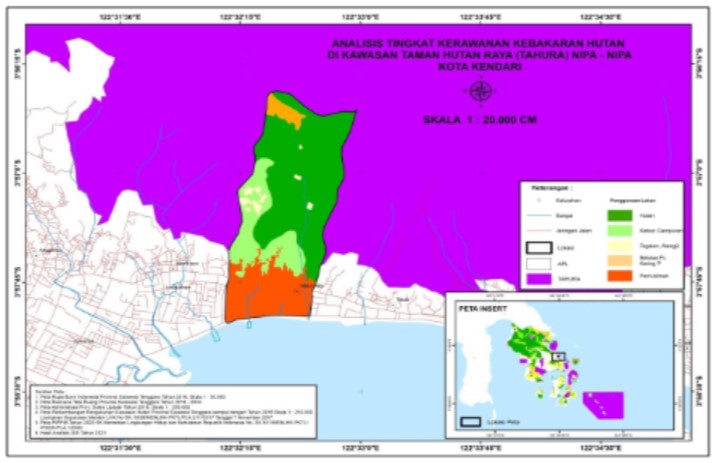
Forest fires are one of the environmental problems that recur almost every year in Indonesia. This problem if not handled properly will certainly cause various negative impacts such as the emergence of haze that can interfere with public health and reduced forest cover, in forest areas. Taman Hutan Raya Nipa-Nipa (Tahura) as one of the Natural Preservation areas of Southeast Sulawesi Province is also inseparable from the problem of forest fires. The aims of the study were to analyze the level of forest fire vulnerability in the Tahura Nipa-Nipa area, especially in Watu-Watu Village, West Kendari Subdistrict, and the variables that most affect the level of forest fire vulnerability. Data analysis based on the weighting of each element is then carried out the determination of the vulnerability class using equations: forest fire vulnerability = {30 % x (land cover)} + {(20 % x height of place)} + {(20 % x Rainfall)} + {(10 % x distance from road)} + {(10 % x distance from river)} + {(10 % x distance from settlement)}. Mapping the class of forest fire vulnerability areas using geoprocessing with input data on land cover, place height, rainfall, and distance from roads, rivers, and settlements. Then an analysis is carried out and will be selected data according to the score of the level of forest fire vulnerability, namely very low/not a vulnerability with a score of 5, low with a score of 4, medium with a score of 3, high with a score of 2, very high /very vulnerability with a score of 1. The results showed that the level of forest fire vulnerability in Tahura Nipa-Nipa has 3 levels, namely the level of high forest fire vulnerability with an area of 68.51 ha, the level of moderate forest fire vulnerability with an area of 62.29 ha, and the level of low fire vulnerability with an area of 143.35 ha. The variables that most affect the level of forest fire vulnerability at the research site are land cover and community accessibility distance in the form of distance from the road and distance from the settlement.
Copyright (c) 2022 Jurnal Wasian

This work is licensed under a Creative Commons Attribution-NonCommercial 4.0 International License.
Copyright and License
All articles published in Wasian Journal are the property of the authors. By submitting an article to Wasian Journal, authors agree to the following terms:
-
Copyright Ownership: The author(s) retain copyright and full publishing rights without restrictions. Authors grant the journal the right to publish the work first and to distribute it as open access under a Creative Commons Attribution 4.0 International License (CC BY 4.0).
-
Licensing: Articles published in Wasian Journal are licensed under a Creative Commons Attribution 4.0 International License (CC BY 4.0). This license allows others to share, copy, and redistribute the material in any medium or format, and adapt, remix, transform, and build upon the material for any purpose, even commercially, provided that proper credit is given to the original author(s) and the source of the material

This work is licensed under a Creative Commons Attribution 4.0 International License. -
Author's Rights: Authors are permitted and encouraged to post their work online (e.g., in institutional repositories or on their website) prior to and during the submission process, as it can lead to productive exchanges and greater citation of published work.
-
Third-Party Content: If your article contains material (e.g., images, tables, or figures) for which you do not hold copyright, you must obtain permission from the copyright holder to use the material in your article. This permission must include the right for you to grant the journal the rights described above.
-
Reprints and Distribution: Authors have the right to distribute the final published version of their work (e.g., post it to an institutional repository or publish it in a book), provided that the original publication in Wasian Journal is acknowledged.
For the reader you are free to:
- Share — copy and redistribute the material in any medium or format for any purpose, even commercially.
- Adapt — remix, transform, and build upon the material for any purpose, even commercially.
- The licensor cannot revoke these freedoms as long as you follow the license terms.
Under the following terms:
- Attribution — You must give appropriate credit , provide a link to the license, and indicate if changes were made . You may do so in any reasonable manner, but not in any way that suggests the licensor endorses you or your use.
- No additional restrictions — You may not apply legal terms or technological measures that legally restrict others from doing anything the license permits.
Notices:
You do not have to comply with the license for elements of the material in the public domain or where your use is permitted by an applicable exception or limitation .
No warranties are given. The license may not give you all of the permissions necessary for your intended use. For example, other rights such as publicity, privacy, or moral rightsmay limit how you use the material.
Similar Articles
- Asjulia Asjulia, Herawaty Herawaty, Dian Mitrnawaty Sultan, Putri Alifiah, Synergy of Ecotourism Strategy, Conservation Awareness, and Social Participation in Supporting Forest Conservation and Ecological Stability , Jurnal Wasian: Vol. 13 No. 01 (2026): June
- Widyanti Utami A, Irlan Irlan, Nur Hilal A Syahrir, Rosmaeni Rosmaeni, Will Indonesia's Forests Survive Development Pressure? Machine Learning Predictions for Energy-Critical Tropical Watersheds , Jurnal Wasian: Vol. 12 No. 01 (2025): June
- Elfrida Kastila Ine Tiga, Lusia Sulo Marimpan, Astin Elise Mau, Nixon Rammang, Assessing Agroforestry Impact on Household Income: A Study of the Bu’u Bei Community Forest (HKm) in Tina Bani Village, Ende, Indonesia , Jurnal Wasian: Vol. 11 No. 2 (2024): December
- Rini Pratiwi, Makkarennu Makkarennu, Ridwan Ridwan, Understanding Traditional Walnut Management System in Forest Communities of Selayar Islands, Indonesia , Jurnal Wasian: Vol. 12 No. 01 (2025): June
- Irlan Irlan, Ulfa Adzkia, Suhartono Suhartono, Meliani Meliani, Alpri Sri Jenos, Teguh Bimantara, Chairil A, Individual Tree Segmentation in TropicalNatural Forest Based on Point CloudGenerated from UAV RGB Image , Jurnal Wasian: Vol. 12 No. 02 (2025): December
- Roslina Yahya, Dr. Hadija Sukri, S.P.,M.P, Dr.Ir. Nirawati., S.Hut.,M.hut.,IPP, Dr. Ira Nurhayati Djarot, Responses of Stomatal Characteristics to Environmental Factors in Fabaceae Trees of the Urban Forest in Maros Regency , Jurnal Wasian: Vol. 12 No. 01 (2025): June
- Sri Arfiani Rahim Sila, S.Hut., M.Hut, Andi Ridha Yayank Wijayanti, S.Hut., M.Hut, DR. hasanuddin Molo, MP, Community-based Strategies for Optimising Mangrove Forest Tourism Management in Balang Baru Village, Jeneponto Regency , Jurnal Wasian: Vol. 12 No. 02 (2025): December
- Andi Nur Imran, Andi Khairil A.Samsu, Muliana Muliana Djafar, Forestry Extension Performance in Enhancing Forest Farmer Knowledge and Skills: A Case Study in Tompobulu, Maros Regency , Jurnal Wasian: Vol. 11 No. 1 (2024): June
- Agustina Sumarni Ciputri Blolok, Wilhelmina Seran, Astin Elise Mau, Muhamad Soimin, Optimising Growing Media Composition and Seed Selection Strategies For the Conversation of the Endangered Sandalwood (Santalum album Linn.) , Jurnal Wasian: Vol. 11 No. 2 (2024): December
- Nurlita Indah Wahyuni , Hendra Susanto Mokodompit, Structure, Composition and Diversity of Tree Species at Inobonto Poigar I Production Forest, Forest Management Unit of Poigar, North Sulawesi , Jurnal Wasian: Vol. 3 No. 1 (2016): June
You may also start an advanced similarity search for this article.