The Success of Root Cuttings is Endangered Kalapi (Kalappia celebica Kosterm.) by Giving Rootone-F Growth Regulator

Abstract
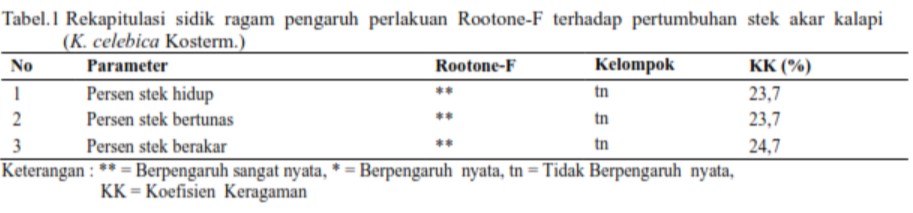
Kalapi (Kalappia celebica Kosterm.) is endemic in Sulawesi and Endangered species. Plant propagation needs to be done but is constrained by limited seeds. Vegetative propagation of plants can be an alternative method such as using the root cutting technique that has been done previously on other types of species. This study aims to determine the success of vegetative propagation of kalapi (K. celebica), an endangered tree species by root cuttings using Rootone F. as root growth regulator. The research took place from March to June 2019 conducted at the plastic house of the Indonesian Mycorrhizal Association (AMI) Southeast Sulawesi Branch, Kendari. This study used a Randomized Block Design (RBD) consisting of 6 treatments of Rootone-F concentration: (a) 0 ppm, (b) 100 ppm, (c) 200 ppm, (d) 300 ppm, (e) 400 ppm and (f) 500 ppm. Each treatment was repeated three times and three units of the plant so that the total experimental unit used was 54 units. The results showed that the provision of Rootone-F could increase the success of the growth of kalapi root cuttings. Rootone-F concentration of 500 ppm gives the best results on the percentage of cuttings, percentage of sprouts, percentage of roots, number of shoots and shoot dry weight. The results showed that kalapi can be propagated by root cuttings.
Copyright (c) 2021 Jurnal Wasian

This work is licensed under a Creative Commons Attribution-NonCommercial 4.0 International License.
Copyright and License
All articles published in Wasian Journal are the property of the authors. By submitting an article to Wasian Journal, authors agree to the following terms:
-
Copyright Ownership: The author(s) retain copyright and full publishing rights without restrictions. Authors grant the journal the right to publish the work first and to distribute it as open access under a Creative Commons Attribution 4.0 International License (CC BY 4.0).
-
Licensing: Articles published in Wasian Journal are licensed under a Creative Commons Attribution 4.0 International License (CC BY 4.0). This license allows others to share, copy, and redistribute the material in any medium or format, and adapt, remix, transform, and build upon the material for any purpose, even commercially, provided that proper credit is given to the original author(s) and the source of the material

This work is licensed under a Creative Commons Attribution 4.0 International License. -
Author's Rights: Authors are permitted and encouraged to post their work online (e.g., in institutional repositories or on their website) prior to and during the submission process, as it can lead to productive exchanges and greater citation of published work.
-
Third-Party Content: If your article contains material (e.g., images, tables, or figures) for which you do not hold copyright, you must obtain permission from the copyright holder to use the material in your article. This permission must include the right for you to grant the journal the rights described above.
-
Reprints and Distribution: Authors have the right to distribute the final published version of their work (e.g., post it to an institutional repository or publish it in a book), provided that the original publication in Wasian Journal is acknowledged.
For the reader you are free to:
- Share — copy and redistribute the material in any medium or format for any purpose, even commercially.
- Adapt — remix, transform, and build upon the material for any purpose, even commercially.
- The licensor cannot revoke these freedoms as long as you follow the license terms.
Under the following terms:
- Attribution — You must give appropriate credit , provide a link to the license, and indicate if changes were made . You may do so in any reasonable manner, but not in any way that suggests the licensor endorses you or your use.
- No additional restrictions — You may not apply legal terms or technological measures that legally restrict others from doing anything the license permits.
Notices:
You do not have to comply with the license for elements of the material in the public domain or where your use is permitted by an applicable exception or limitation .
No warranties are given. The license may not give you all of the permissions necessary for your intended use. For example, other rights such as publicity, privacy, or moral rightsmay limit how you use the material.
Similar Articles
- Andika Lalu, Sitti Ramlah, Reinaldi Reinaldi, When Strong Institutions Meet Weak Economies: Lessons from Ecotourism Sustainability in Lombuyan Wildlife Sanctuary, Central Sulawesi , Jurnal Wasian: Vol. 12 No. 02 (2025): December
- Agustina Sumarni Ciputri Blolok, Wilhelmina Seran, Astin Elise Mau, Muhamad Soimin, Optimising Growing Media Composition and Seed Selection Strategies For the Conversation of the Endangered Sandalwood (Santalum album Linn.) , Jurnal Wasian: Vol. 11 No. 2 (2024): December
- Asikin Muchtar, Nirwana Nirwana, Wahyullah Wahyullah, Mahmud Mahmud, Ummu Kultsum, Analysis of the Success and Vigour of Cashew Seedlings Through Direct Seed Planting (Anacardium occidentale L.) for Sustainable Land Management , Jurnal Wasian: Vol. 11 No. 2 (2024): December
- Ratna Damayanti Siantur, Dede J Sudrajat, Correlation of Morphological Characteristics of Nyamplung Seedling (Calophyllum inophyllum L) with The Performance at Field Condition , Jurnal Wasian: Vol. 6 No. 1 (2019): June
- Faisal Danu Tuheteru, Asrianti Arif, Fauzi Rajab, Potential of Nickel (Ni) Phytoremediation of Adaptive Species on Revegetation Land, PT. Vale Indonesia (Tbk). Pomalaa Site Kolaka Regency , Jurnal Wasian: Vol. 4 No. 2 (2017): December
- Muh Faisal Mappiasse, Andi Nurul Mukhlisa , Recognition and Analysis of Pest-Induced Damage in Mangrove Ecosystems: A Case Study in Maros Coastal Region , Jurnal Wasian: Vol. 11 No. 2 (2024): December
- Ady Suryawan, Margaretta Christita, Endro Subiandono, Survival Rate, Growth and Seedling Quality Index of Baringtonia Asiatica Kurz Stump Due to Length Variation of Stems and Roots , Jurnal Wasian: Vol. 3 No. 2 (2016): December
- Irlan Irlan, Ulfa Adzkia, Suhartono Suhartono, Meliani Meliani, Alpri Sri Jenos, Teguh Bimantara, Chairil A, Individual Tree Segmentation in TropicalNatural Forest Based on Point CloudGenerated from UAV RGB Image , Jurnal Wasian: Vol. 12 No. 02 (2025): December
- Sahindomi Bana, Wa Ode Nur Hasanah, Laode Sabaruddin, Hasbullah Syaf, Lies Indriyani, Junartin Teke, La Gandri, The Analyses of Forest Fire Vulnerability at Taman Hutan Raya (Tahura) Nipa-Nipa Kendari City , Jurnal Wasian: Vol. 9 No. 1 (2022): June
- Muhammad Abdul Qirom, Acep Akbar, The Volume Model of Tree Species Group in Peat Swamp Forest at Logging Concession Area of Tingang Karya Mandiri, Central Kalimantan , Jurnal Wasian: Vol. 7 No. 1 (2020): June
You may also start an advanced similarity search for this article.
Most read articles by the same author(s)
- Faisal Danu Tuheteru, Asrianti Arif, Fauzi Rajab, Potential of Nickel (Ni) Phytoremediation of Adaptive Species on Revegetation Land, PT. Vale Indonesia (Tbk). Pomalaa Site Kolaka Regency , Jurnal Wasian: Vol. 4 No. 2 (2017): December