Habitat Characteristics and Diet of Bear Cuscus (Ailurops ursinus) in Tanjung Peropa Wildlife Reserve, Southeast Sulawesi

Abstract
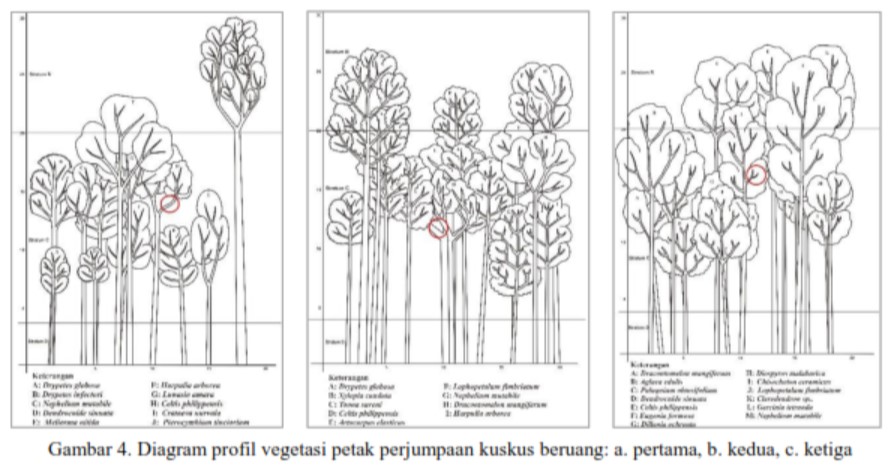
Bear cuscus (Ailurops ursinus) which is vulnerable in the IUCN Redlist, is one of the endemic protected animal that lives in the lowland forests of Sulawesi. This research aimed to identify habitat characteristics, diet, and daily activities of bear cuscus in Tanjung Peropa Wildlife Reserve, Southeast Sulawesi. This research was carried out from February to March 2017. Habitat characteristics were identified using vegetation analysis, diet were identified using direct and non-direct observation, and daily activities were identified using ad-libitum sampling. The highest important value index of tree at the Mobula path and Mata Air path were Pisonia umbellifera (28.33 %) and Chisocheton ceramicus (44.72 %), respectively. The vegetation species diversity was high and the vegetation species evenness was distributed. A total of 80 species of plants were recorded which are the potential diet of bear cuscus. The highest percentage parts of plants that bear cuscus consumed were shoot (36.19 %) and young leaves (36.19 %). Bear cuscus daily activities were resting (89.05 %), moving (5.83 %), foraging (2.71 %), and feeding (2.41%). Bear cuscus preferred the C stratum of vegetation for their daily activities.
Copyright (c) 2017 Jurnal Wasian

This work is licensed under a Creative Commons Attribution-NonCommercial 4.0 International License.
Copyright and License
All articles published in Wasian Journal are the property of the authors. By submitting an article to Wasian Journal, authors agree to the following terms:
-
Copyright Ownership: The author(s) retain copyright and full publishing rights without restrictions. Authors grant the journal the right to publish the work first and to distribute it as open access under a Creative Commons Attribution 4.0 International License (CC BY 4.0).
-
Licensing: Articles published in Wasian Journal are licensed under a Creative Commons Attribution 4.0 International License (CC BY 4.0). This license allows others to share, copy, and redistribute the material in any medium or format, and adapt, remix, transform, and build upon the material for any purpose, even commercially, provided that proper credit is given to the original author(s) and the source of the material

This work is licensed under a Creative Commons Attribution 4.0 International License. -
Author's Rights: Authors are permitted and encouraged to post their work online (e.g., in institutional repositories or on their website) prior to and during the submission process, as it can lead to productive exchanges and greater citation of published work.
-
Third-Party Content: If your article contains material (e.g., images, tables, or figures) for which you do not hold copyright, you must obtain permission from the copyright holder to use the material in your article. This permission must include the right for you to grant the journal the rights described above.
-
Reprints and Distribution: Authors have the right to distribute the final published version of their work (e.g., post it to an institutional repository or publish it in a book), provided that the original publication in Wasian Journal is acknowledged.
For the reader you are free to:
- Share — copy and redistribute the material in any medium or format for any purpose, even commercially.
- Adapt — remix, transform, and build upon the material for any purpose, even commercially.
- The licensor cannot revoke these freedoms as long as you follow the license terms.
Under the following terms:
- Attribution — You must give appropriate credit , provide a link to the license, and indicate if changes were made . You may do so in any reasonable manner, but not in any way that suggests the licensor endorses you or your use.
- No additional restrictions — You may not apply legal terms or technological measures that legally restrict others from doing anything the license permits.
Notices:
You do not have to comply with the license for elements of the material in the public domain or where your use is permitted by an applicable exception or limitation .
No warranties are given. The license may not give you all of the permissions necessary for your intended use. For example, other rights such as publicity, privacy, or moral rightsmay limit how you use the material.
Similar Articles
- Diah Irawati Dwi Arini, Julianus Kinho, Melkianus S Diwi, Margareta Christita, Jafred E Halawane, Muhammad F Fahmi, Yermias Kafiar, Wildlife Diversity for Ecotourism at Aqua Lestari Forest Park, North Minahasa , Jurnal Wasian: Vol. 5 No. 1 (2018): June
- Asikin Muchtar, Nirwana Nirwana, Wahyullah Wahyullah, Mahmud Mahmud, Ummu Kultsum, Analysis of the Success and Vigour of Cashew Seedlings Through Direct Seed Planting (Anacardium occidentale L.) for Sustainable Land Management , Jurnal Wasian: Vol. 11 No. 2 (2024): December
- Ratih Madya Septiana, Nunuk Supriyatno, Slamet Riyanto, Socio Demographic Factors and Work Performance of Forest Workers in Cajuput Leaf Harvesting at RPH Nglipar, KPH Yogyakarta , Jurnal Wasian: Vol. 7 No. 2 (2020): December
- Ni Putu Sri Asih, I Gusti Made Sudirga, I Gede - Tirta, The Diversity, Distribution and Conservation of Bali’s Medinilla in Eka Karya Bali Botanical Garden , Jurnal Wasian: Vol. 8 No. 2 (2021): December
- Supratman Tabba, Lis Nurrani, Distribution of Avifauna in Aketajawe Lolobata National Park Based on Zone and Land Cover Typology , Jurnal Wasian: Vol. 3 No. 1 (2016): June
- Febriyani , Faisal Danu Tuheteru, Asrianti Arif, Husna Husna, The Success of Root Cuttings is Endangered Kalapi (Kalappia celebica Kosterm.) by Giving Rootone-F Growth Regulator , Jurnal Wasian: Vol. 8 No. 2 (2021): December
- Poppy Oktadiyani, Iwanuddin, Helwinsyah, Ecotourism Development Strategy Of Wera Nature Recreation Park (NRP) , Jurnal Wasian: Vol. 2 No. 1 (2015): March
- Rubangi Al Hasan, Krisnawati Krisnawati, Anita AD Rahayu, Preservation Efforts of Pranajiwa (Euchresta horsfieldii (Lesch.) Benn.) Based on Tri Hita Karana by Balinese Community , Jurnal Wasian: Vol. 9 No. 1 (2022): June
- Ratna Damayanti Siantur, Dede J Sudrajat, Correlation of Morphological Characteristics of Nyamplung Seedling (Calophyllum inophyllum L) with The Performance at Field Condition , Jurnal Wasian: Vol. 6 No. 1 (2019): June
- Arif Irawan, Iwanuddin Iwanuddin, Effectivity of Using Growth Retardants on Shorea assamica Dyer Seedling at Nursery , Jurnal Wasian: Vol. 2 No. 1 (2015): March
You may also start an advanced similarity search for this article.