Perencanaan Rehabilitasi Hutan Dan Lahan (Rhl) Berbasis Kemampuan Lahan Di Daerah Tangkapan Air (Dta) Danau Tondano

Abstract
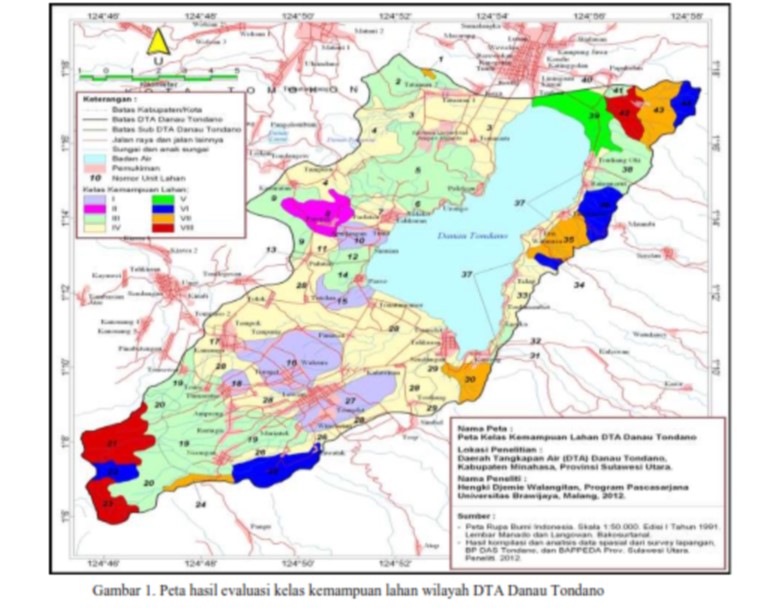
Penelitian ini bertujuan menganalisis dan mengembangkan alternatif rehabilitasi hutan dan lahan (RHL) berdasarkan kemampuan lahan di daerah tangkapan air (DTA) Danau Tondano. Metode evaluasi kemampuan lahan menggunakan pedoman intensitas faktor penghambat yaitu faktor lereng, drainase dan laju infiltrasi dan dianalisis dengan menggunakan Sistem Informasi Geografis (SIG). Sedangkan arahan penggunaan lahan yang ideal pada setiap kemampuan lahan sebagai dasar perencanaan. Hasil analisis spasial diperoleh data luas masing-masing kelas kemampuan lahan sebagai berikut : kelas kemampuan I seluas 2.041,13 ha (11,05 %), lahan kelas II seluas 348,35 ha (1,89 %), lahan kelas III seluas 5.681,27 ha (30,76 %), lahan kelas IV seluas 7.107,37 ha (38,49 %), lahan kelas V
seluas 475,23 ha (2,57 %) lahan kelas VI seluas 957,98 ha ( 5,19 %), lahan kelas VII seluas 1.125,2 ha (6,09%) dan lahan kelas VIII seluas 730,58 ha ( 3,96 %). Berdasarkan hasil evaluasi penggunaan lahan menurut kelampuan lahan saat ini maka dikembangkan arahan RHL sebagai berikut : sekitar 85 % wilayah DTA danau Tondano tergolong dalam kelas kemampuan lahan I sampai kelas V, lahan tersebut dikembangkan sebagai lahan pertanian intensif dengan konservasi tanah pengembangan pertanian organik dalam berbagai variasi implementasi. Selanjutnya sekitar 15 % lainnya dapat dimanfaatkan sebagai kawasan pertanian terbatas dengan tindakan konservasi tanah berupa penyempurnaan sistem agroforestry, pengembangan agroforestry berbasis tanaman cengkih yang tertata atau pengembangan hutan serbaguna pada kawasan hutan lindung dan hutan produksi dengan tanaman penghasil hasil
hutan non kayu (aren, bambu) dan jasa lingkungan.
Copyright (c) 2014 Jurnal Wasian

This work is licensed under a Creative Commons Attribution-NonCommercial 4.0 International License.
Copyright and License
All articles published in Wasian Journal are the property of the authors. By submitting an article to Wasian Journal, authors agree to the following terms:
-
Copyright Ownership: The author(s) retain copyright and full publishing rights without restrictions. Authors grant the journal the right to publish the work first and to distribute it as open access under a Creative Commons Attribution 4.0 International License (CC BY 4.0).
-
Licensing: Articles published in Wasian Journal are licensed under a Creative Commons Attribution 4.0 International License (CC BY 4.0). This license allows others to share, copy, and redistribute the material in any medium or format, and adapt, remix, transform, and build upon the material for any purpose, even commercially, provided that proper credit is given to the original author(s) and the source of the material

This work is licensed under a Creative Commons Attribution 4.0 International License. -
Author's Rights: Authors are permitted and encouraged to post their work online (e.g., in institutional repositories or on their website) prior to and during the submission process, as it can lead to productive exchanges and greater citation of published work.
-
Third-Party Content: If your article contains material (e.g., images, tables, or figures) for which you do not hold copyright, you must obtain permission from the copyright holder to use the material in your article. This permission must include the right for you to grant the journal the rights described above.
-
Reprints and Distribution: Authors have the right to distribute the final published version of their work (e.g., post it to an institutional repository or publish it in a book), provided that the original publication in Wasian Journal is acknowledged.
For the reader you are free to:
- Share — copy and redistribute the material in any medium or format for any purpose, even commercially.
- Adapt — remix, transform, and build upon the material for any purpose, even commercially.
- The licensor cannot revoke these freedoms as long as you follow the license terms.
Under the following terms:
- Attribution — You must give appropriate credit , provide a link to the license, and indicate if changes were made . You may do so in any reasonable manner, but not in any way that suggests the licensor endorses you or your use.
- No additional restrictions — You may not apply legal terms or technological measures that legally restrict others from doing anything the license permits.
Notices:
You do not have to comply with the license for elements of the material in the public domain or where your use is permitted by an applicable exception or limitation .
No warranties are given. The license may not give you all of the permissions necessary for your intended use. For example, other rights such as publicity, privacy, or moral rightsmay limit how you use the material.
Similar Articles
- Rahmia Nugraha, Abdul Haris Mustari, Habitat Characteristics and Diet of Bear Cuscus (Ailurops ursinus) in Tanjung Peropa Wildlife Reserve, Southeast Sulawesi , Jurnal Wasian: Vol. 4 No. 2 (2017): December
- Encep Rachman, Aditya Hani, The Potential of Vegetation Species Diversity for Ecotorourism Development at Nature Reserve of Panjalu Lake , Jurnal Wasian: Vol. 4 No. 1 (2017): June
- Wahyullah Wahyullah, Yefane Samperuru, Impact of Land Use Change on Water Yield Using the SWAT Model in the Minraleng Sub-Watershed, Maros , Jurnal Wasian: Vol. 13 No. 01 (2026): June
- Mashudi, Growth of 5 Provenances at 6 Months Old Alstonia Scholaris in Sumber Klampok, Bali (Pertumbuhan Lima Provenan Pulai Gading (Alstonia Scholaris) Umur 6 Bulan di Sumber Klampok, Bali) , Jurnal Wasian: Vol. 2 No. 2 (2015): December
- Lis Nurrani, M Bismark, Supratman Tabba, Institution and Communities Participation in the Conservation Of Mangrove/Case Study in Tiwoho Village, North Province , Jurnal Wasian: Vol. 2 No. 1 (2015): March
- Yonky Indrajaya, The Study of Faustmann Formula Application in Sustainable Natural Forest Management in Indonesia , Jurnal Wasian: Vol. 5 No. 1 (2018): June
- Lis Nurrani, Halidah, Supratman Tabba, Ethnic Influence Against Land Use Patterns and Its Contribution to Community Income in The Aketajawe Lolobata National Park (Pengaruh Etnis Terhadap Pola Pemanfaatan Lahan Dan Kontribusinya Bagi Pendapatan Masyarakat Di Taman Nasional Aketajawe Lolobata) , Jurnal Wasian: Vol. 2 No. 2 (2015): December
- Yulianti Bramasto, Nurheni Wijayanto, Iskandar Z Siregar, I.G.K. Tapa Darma, The Variability of Seed Viability and Seed Vigour of Mindi (Melia azedarachlinn.) from Several Populations in The Community Forest of West Java , Jurnal Wasian: Vol. 3 No. 2 (2016): December
- Naning Yuniarti, The Invigoration Techniques of Nyamplung (Calophyllum inophyllum L.) Seeds During the Storage , Jurnal Wasian: Vol. 7 No. 1 (2020): June
- Afief Rif'an, Fadjri Maarif, Delima Ayu Gustina Situmorang, Understanding Generation Z's Ecotourism Motivation and Perception in Central Sulawesi , Jurnal Wasian: Vol. 11 No. 2 (2024): December
You may also start an advanced similarity search for this article.