Stakeholder Analysis of Implementation of Social Forestry Program at KPH Telawa, Central Java

Abstract
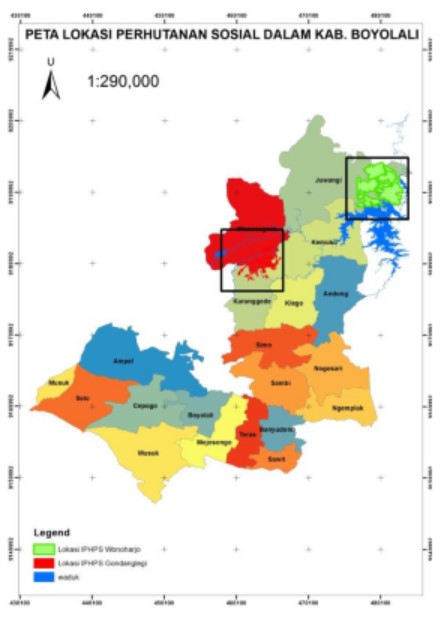
Social Forestry at Java island or known as IPHPS (Permit for the Utilization of Social Forestry) is part of the agrarian reform of the forestry sector which expected to solve tenurial problems and improve forest governance. The successful implementation of this program could not be separated of the roles of stakeholder involved. This study aimed to 1) identified stakeholders and their roles in the implementation of IPHPS, and 2) analyzed the relationships between stakeholders in the implementation of IPHPS. This research was conducted in the KPH Telawa area of Boyolali Regency, Central Java. This research uses a combination of qualitative and quantitative approaches. Data collection was done by observation, interviews, and literature studies. Data were analyzed based on the research objectives at stakeholder analysis conducted by identifying stakeholders and their roles as well as the relationships between them in the implementation of IPHPS. They involved in the implementation of IPHPS at the Telawa KPH included Perhutani (KPH) Telawa, KTH IPHPS holders (Wonomakmur 1, Wonomakmur 2, Wonolestari 1, and Wonolestari 2) LMDH Participants PHBM, BPKH IX, BPDASHL Pemali Jratun, Field Companion, BDK Kadipaten, Forestry Foundation, NGO Rejo Semut Ireng, PSKL, LHK Office of Central Java Province, BPSKL Jabalnusra, Forest Development Financing Center Public Service Agency (P3H-BLU). Each of the above stakeholders has their respective strengths and interests. This affects the pattern of relations between the stakeholders which in turn will determine the results of the program. A good relationship will support the successful implementation of the program while a bad relationship can hamper the implementation of the program.
Copyright (c) 2021 Jurnal Wasian

This work is licensed under a Creative Commons Attribution-NonCommercial 4.0 International License.
Copyright and License
All articles published in Wasian Journal are the property of the authors. By submitting an article to Wasian Journal, authors agree to the following terms:
-
Copyright Ownership: The author(s) retain copyright and full publishing rights without restrictions. Authors grant the journal the right to publish the work first and to distribute it as open access under a Creative Commons Attribution 4.0 International License (CC BY 4.0).
-
Licensing: Articles published in Wasian Journal are licensed under a Creative Commons Attribution 4.0 International License (CC BY 4.0). This license allows others to share, copy, and redistribute the material in any medium or format, and adapt, remix, transform, and build upon the material for any purpose, even commercially, provided that proper credit is given to the original author(s) and the source of the material

This work is licensed under a Creative Commons Attribution 4.0 International License. -
Author's Rights: Authors are permitted and encouraged to post their work online (e.g., in institutional repositories or on their website) prior to and during the submission process, as it can lead to productive exchanges and greater citation of published work.
-
Third-Party Content: If your article contains material (e.g., images, tables, or figures) for which you do not hold copyright, you must obtain permission from the copyright holder to use the material in your article. This permission must include the right for you to grant the journal the rights described above.
-
Reprints and Distribution: Authors have the right to distribute the final published version of their work (e.g., post it to an institutional repository or publish it in a book), provided that the original publication in Wasian Journal is acknowledged.
For the reader you are free to:
- Share — copy and redistribute the material in any medium or format for any purpose, even commercially.
- Adapt — remix, transform, and build upon the material for any purpose, even commercially.
- The licensor cannot revoke these freedoms as long as you follow the license terms.
Under the following terms:
- Attribution — You must give appropriate credit , provide a link to the license, and indicate if changes were made . You may do so in any reasonable manner, but not in any way that suggests the licensor endorses you or your use.
- No additional restrictions — You may not apply legal terms or technological measures that legally restrict others from doing anything the license permits.
Notices:
You do not have to comply with the license for elements of the material in the public domain or where your use is permitted by an applicable exception or limitation .
No warranties are given. The license may not give you all of the permissions necessary for your intended use. For example, other rights such as publicity, privacy, or moral rightsmay limit how you use the material.
Similar Articles
- Faisal Danu Tuheteru, Asrianti Arif, Fauzi Rajab, Potential of Nickel (Ni) Phytoremediation of Adaptive Species on Revegetation Land, PT. Vale Indonesia (Tbk). Pomalaa Site Kolaka Regency , Jurnal Wasian: Vol. 4 No. 2 (2017): December
- Liliek Haryjanto, Prastyono , Charomaini Z, Genetic Variation in Growth Traits of Two Years Old Ficus variegata Blume , Jurnal Wasian: Vol. 2 No. 1 (2015): March
- Poppy Oktadiyani, Iwanuddin, Helwinsyah, Ecotourism Development Strategy Of Wera Nature Recreation Park (NRP) , Jurnal Wasian: Vol. 2 No. 1 (2015): March
- Tri Sayektiningsih, Ardiyanto Wahyu Nugroho, Ishak Yassir, Ulfah Karmila Sari, Amir Ma'ruf, Mukhlisi Mukhlisi, Adi Surya, Suryanto Suryanto, Community Perceptions of Impacts of Ecotourism and Its Implications on Ecotourism Development in the Balikpapan Bay, East Kalimantan , Jurnal Wasian: Vol. 6 No. 1 (2019): June
- Mujahidah Sylviari Zaenal, Tatang Tiryana, Muhdin Muhdin, Allometric Models for Estimating Tree Biomass of Dryland Secondary Forest in East Halmahera , Jurnal Wasian: Vol. 7 No. 2 (2020): December
- Naning Yuniarti, The Invigoration Techniques of Nyamplung (Calophyllum inophyllum L.) Seeds During the Storage , Jurnal Wasian: Vol. 7 No. 1 (2020): June
- Eritrina Windyarini, Budi Leksono, Tri Maria Hasna, Compost Quality of Nyamplung (Calophyllum inophyllum L.) Solid Waste Oil Industri with Four Starters , Jurnal Wasian: Vol. 5 No. 2 (2018): December
- Mohamad Siarudin, Yonky Indrajaya, Carbon Stock Dinamics of Gmelina (Gmellina arborea Roxb.) based Agroforestry in Private Forest, Tasikmalaya and Banjar District, West Java , Jurnal Wasian: Vol. 4 No. 1 (2017): June
- Ady Suryawan, Margaretta Christita, Endro Subiandono, Survival Rate, Growth and Seedling Quality Index of Baringtonia Asiatica Kurz Stump Due to Length Variation of Stems and Roots , Jurnal Wasian: Vol. 3 No. 2 (2016): December
- Nurlita Indah Wahyuni , Hendra Susanto Mokodompit, Structure, Composition and Diversity of Tree Species at Inobonto Poigar I Production Forest, Forest Management Unit of Poigar, North Sulawesi , Jurnal Wasian: Vol. 3 No. 1 (2016): June
You may also start an advanced similarity search for this article.
Most read articles by the same author(s)
- Baharinawati Wilhan Hastanti, Freddy Jontara Hutapea, Analysis of Vulnerability Levels to the Flash Flood Based on Social Economic and Institutional Factors in Wasior, Teluk Wondama, West Papua , Jurnal Wasian: Vol. 7 No. 1 (2020): June
- Baharinawati Wilhan Hastanti, Relawan Kuswandi, Julanda Noya, Development Strategy of Masoi (Cryptocarya massoia (Oken) Kosterm.) as Non-Timber Forest Products in Teluk Bintuni, West Papua With SWOT Analysis , Jurnal Wasian: Vol. 5 No. 1 (2018): June