Allometric Models for Estimating Tree Biomass of Dryland Secondary Forest in East Halmahera

Abstract
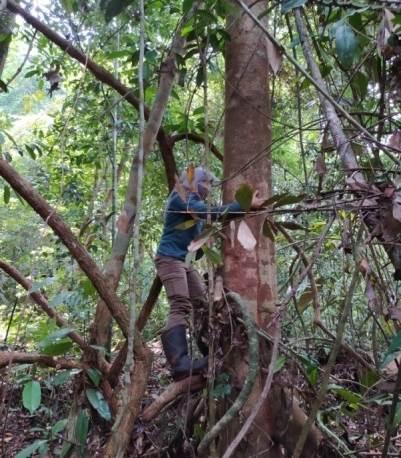
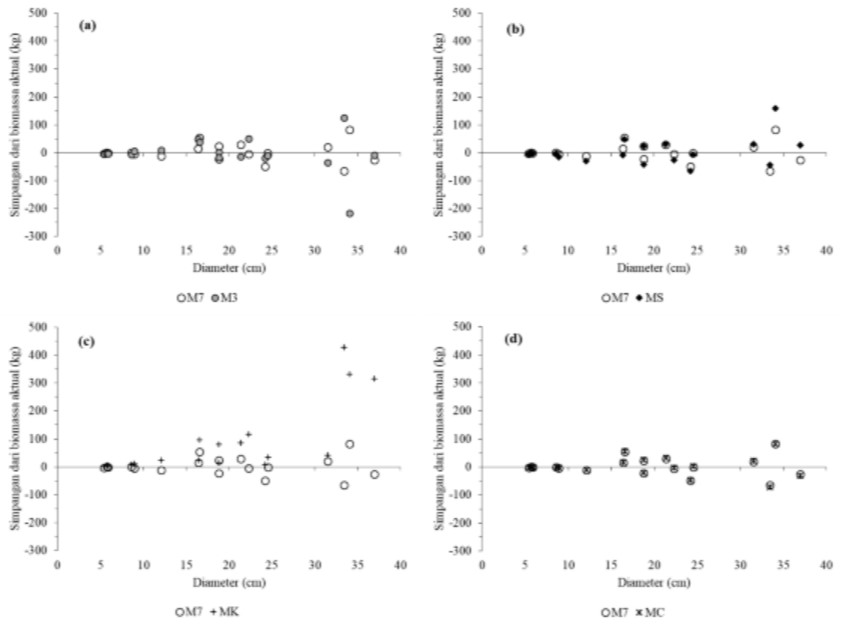
Biomass estimation of secondary forests is required to support the emission reduction of carbon dioxide through an enhancement of forest carbon stocks. Commonly, forest biomass is indirectly estimated using tree biomass allometric models that are developed based on a destructive sampling of sample trees. The availability of biomass allometric models for secondary forests in Indonesia is still limited, particularly for secondary forest ecosystems in eastern Indonesia. This study aimed to develop allometric biomass models for mixed-species trees in a secondary forest of East Halmahera, North Maluku, and to compare their accuracies with some other allometric biomass models that commonly used for estimating biomass of secondary forests. The tree biomass measurement was conducted by using a destructive sampling of 18 mixed-species trees (with diameter range of 5,4 – 36,9 cm) in a secondary forest. The samples of each tree component (stem, branch, twig, and leaf) were analyzed in a laboratory to determine the biomass of each sample tree. Allometric models were developed by using a non-linear regression analysis, which were then compared with other allometric models. This study revealed that the biomass of mixed-species trees in the study area could be estimated accurately using the M7 model that used diameter, height, and wood density variables. Such local allometric model was more accurate than other allometric models commonly used for estimating tropical forest biomass. Alternatively, the M3 model that used diameter and height variables could also be used when wood density data was not available. The local allometric models from this study can enrich the availability of biomass allometric models for secondary forest ecosystems in eastern Indonesia.
Copyright (c) 2020 Jurnal Wasian

This work is licensed under a Creative Commons Attribution-NonCommercial 4.0 International License.
Copyright and License
All articles published in Wasian Journal are the property of the authors. By submitting an article to Wasian Journal, authors agree to the following terms:
-
Copyright Ownership: The author(s) retain copyright and full publishing rights without restrictions. Authors grant the journal the right to publish the work first and to distribute it as open access under a Creative Commons Attribution 4.0 International License (CC BY 4.0).
-
Licensing: Articles published in Wasian Journal are licensed under a Creative Commons Attribution 4.0 International License (CC BY 4.0). This license allows others to share, copy, and redistribute the material in any medium or format, and adapt, remix, transform, and build upon the material for any purpose, even commercially, provided that proper credit is given to the original author(s) and the source of the material

This work is licensed under a Creative Commons Attribution 4.0 International License. -
Author's Rights: Authors are permitted and encouraged to post their work online (e.g., in institutional repositories or on their website) prior to and during the submission process, as it can lead to productive exchanges and greater citation of published work.
-
Third-Party Content: If your article contains material (e.g., images, tables, or figures) for which you do not hold copyright, you must obtain permission from the copyright holder to use the material in your article. This permission must include the right for you to grant the journal the rights described above.
-
Reprints and Distribution: Authors have the right to distribute the final published version of their work (e.g., post it to an institutional repository or publish it in a book), provided that the original publication in Wasian Journal is acknowledged.
For the reader you are free to:
- Share — copy and redistribute the material in any medium or format for any purpose, even commercially.
- Adapt — remix, transform, and build upon the material for any purpose, even commercially.
- The licensor cannot revoke these freedoms as long as you follow the license terms.
Under the following terms:
- Attribution — You must give appropriate credit , provide a link to the license, and indicate if changes were made . You may do so in any reasonable manner, but not in any way that suggests the licensor endorses you or your use.
- No additional restrictions — You may not apply legal terms or technological measures that legally restrict others from doing anything the license permits.
Notices:
You do not have to comply with the license for elements of the material in the public domain or where your use is permitted by an applicable exception or limitation .
No warranties are given. The license may not give you all of the permissions necessary for your intended use. For example, other rights such as publicity, privacy, or moral rightsmay limit how you use the material.
Similar Articles
- Anita Mayasari, Margaretta Christita, Ady Suryawan, The Diversity of Macroscopic Fungi Species of The Wallacea in The Arboretum of BP2LHK Manado , Jurnal Wasian: Vol. 5 No. 2 (2018): December
- Muhammad Abdul Qirom, Development and Validation of Volume Prediction Model for Balangeran (Shorea balangeran (Korth.) Burck) In Central Kalimantan , Jurnal Wasian: Vol. 5 No. 2 (2018): December
- Sahindomi Bana, Wa Ode Nur Hasanah, Laode Sabaruddin, Hasbullah Syaf, Lies Indriyani, Junartin Teke, La Gandri, The Analyses of Forest Fire Vulnerability at Taman Hutan Raya (Tahura) Nipa-Nipa Kendari City , Jurnal Wasian: Vol. 9 No. 1 (2022): June
- Diah Irawati Dwi Arini, Isdomo Yuliantoro, Perception of Local Community of Pinogu Toward Forest and Its Utilization , Jurnal Wasian: Vol. 6 No. 2 (2019): December
- Diah Irawati Dwi Arini, Birds Species of Rallidae Family in Forestry and Environment Research and Development Institute of Manado , Jurnal Wasian: Vol. 3 No. 1 (2016): June
- Eva Fauziyah, Sanudin sanuddin, The Effectiveness of Private Forest Institutional and Policy in Banjarnegara and Banyumas Regency , Jurnal Wasian: Vol. 4 No. 2 (2017): December
- Ratih Madya Septiana, Nunuk Supriyatno, Slamet Riyanto, Socio Demographic Factors and Work Performance of Forest Workers in Cajuput Leaf Harvesting at RPH Nglipar, KPH Yogyakarta , Jurnal Wasian: Vol. 7 No. 2 (2020): December
- Baharinawati Wilhan Hastanti, Relawan Kuswandi, Julanda Noya, Development Strategy of Masoi (Cryptocarya massoia (Oken) Kosterm.) as Non-Timber Forest Products in Teluk Bintuni, West Papua With SWOT Analysis , Jurnal Wasian: Vol. 5 No. 1 (2018): June
- Yulianti Bramasto, Nurheni Wijayanto, Iskandar Z Siregar, I.G.K. Tapa Darma, The Variability of Seed Viability and Seed Vigour of Mindi (Melia azedarachlinn.) from Several Populations in The Community Forest of West Java , Jurnal Wasian: Vol. 3 No. 2 (2016): December
- Endah Suhaendah, Benyamin Dendang, Weed Density and Dominant Weed Species in Malapari (Pongamia pinnata (L.) Pierre) Agroforestry , Jurnal Wasian: Vol. 6 No. 1 (2019): June
You may also start an advanced similarity search for this article.