Analysis Of Tenurial Conflict In Production Forest Management Unit (Pfmu) Model Poiga

Abstract
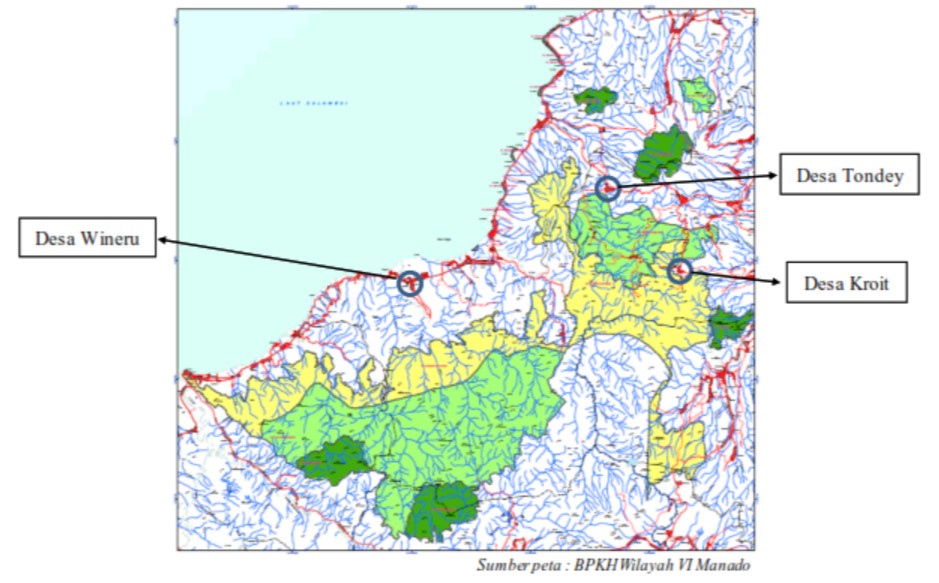
This Research aims to determine (1) History, actors and the causes of conflict in terms of the social aspect of economic, cultural and institutional happened in PFMU Model Poigar (2)
Recommendations settlement to parse tenurial conflicts PFMU Model Poigar. Data analysis method used is a qualitative approach. The results showed that land claims by communities began of forest utilization activities to meet basic needs. Tenurial conflicts PFMU Model Poigar is a structural conflict. Some of the main actors should receive priority attention is the processing community land in the area and local employers. Some of the basic causes of conflict tenurial PFMU Model Poigar is a lack of understanding about the existence of related parties PFMU Model Poigar, the dualism of authority, lack of community empowerment, and law enforcement is still weak.Based on consideration of the history, the actors involved and the cause of the conflict, then some of the recommendation of this study is the institutional strengthening KPHP Poigar model, the development of that partnership, and law enforcement.
Copyright (c) 2016 Jurnal Wasian

This work is licensed under a Creative Commons Attribution-NonCommercial 4.0 International License.
Copyright and License
All articles published in Wasian Journal are the property of the authors. By submitting an article to Wasian Journal, authors agree to the following terms:
-
Copyright Ownership: The author(s) retain copyright and full publishing rights without restrictions. Authors grant the journal the right to publish the work first and to distribute it as open access under a Creative Commons Attribution 4.0 International License (CC BY 4.0).
-
Licensing: Articles published in Wasian Journal are licensed under a Creative Commons Attribution 4.0 International License (CC BY 4.0). This license allows others to share, copy, and redistribute the material in any medium or format, and adapt, remix, transform, and build upon the material for any purpose, even commercially, provided that proper credit is given to the original author(s) and the source of the material

This work is licensed under a Creative Commons Attribution 4.0 International License. -
Author's Rights: Authors are permitted and encouraged to post their work online (e.g., in institutional repositories or on their website) prior to and during the submission process, as it can lead to productive exchanges and greater citation of published work.
-
Third-Party Content: If your article contains material (e.g., images, tables, or figures) for which you do not hold copyright, you must obtain permission from the copyright holder to use the material in your article. This permission must include the right for you to grant the journal the rights described above.
-
Reprints and Distribution: Authors have the right to distribute the final published version of their work (e.g., post it to an institutional repository or publish it in a book), provided that the original publication in Wasian Journal is acknowledged.
For the reader you are free to:
- Share — copy and redistribute the material in any medium or format for any purpose, even commercially.
- Adapt — remix, transform, and build upon the material for any purpose, even commercially.
- The licensor cannot revoke these freedoms as long as you follow the license terms.
Under the following terms:
- Attribution — You must give appropriate credit , provide a link to the license, and indicate if changes were made . You may do so in any reasonable manner, but not in any way that suggests the licensor endorses you or your use.
- No additional restrictions — You may not apply legal terms or technological measures that legally restrict others from doing anything the license permits.
Notices:
You do not have to comply with the license for elements of the material in the public domain or where your use is permitted by an applicable exception or limitation .
No warranties are given. The license may not give you all of the permissions necessary for your intended use. For example, other rights such as publicity, privacy, or moral rightsmay limit how you use the material.
Similar Articles
- Unequal Value Capture in Non-TimberForest Product Chains with Evidence fromPine Resin Processing in Rural Indonesia View PDF
- Synergy of Ecotourism Strategy, Conservation Awareness, and Social Participation in Supporting Forest Conservation and Ecological Stability View PDF
- Ecotourism Management of Oelsonbai Forest in Circular Economy Perspective: Community Participation, Economic Value, and Sustainability Opportunities View PDF
- Assessment and Spatial Mapping of Soil Degradation Status in Bontoharu District, Selayar Islands Regency: A Framework for Sustainable Land Management View PDF
- Individual Tree Segmentation in TropicalNatural Forest Based on Point CloudGenerated from UAV RGB Image View PDF
- Estimation of Carbon Stock in Gambesi Mangrove Ecosystem as an Action Toward Achieving the Sustainable Development Goals View PDF
You may also start an advanced similarity search for this article.
Most read articles by the same author(s)
- Shade Effect on Growth and Quality of Cempaka Wasian Seedling (Magnolia tsiampaca (Miq.) Dandy) in Nursery View PDF
- The Effect of Weaning Tecnique to Survival Rate and Height Growth of Nyamplung (Calophyllum inophyllum) Plant View PDF