Perencanaan Rehabilitasi Hutan Dan Lahan (Rhl) Berbasis Kemampuan Lahan Di Daerah Tangkapan Air (Dta) Danau Tondano

Abstract
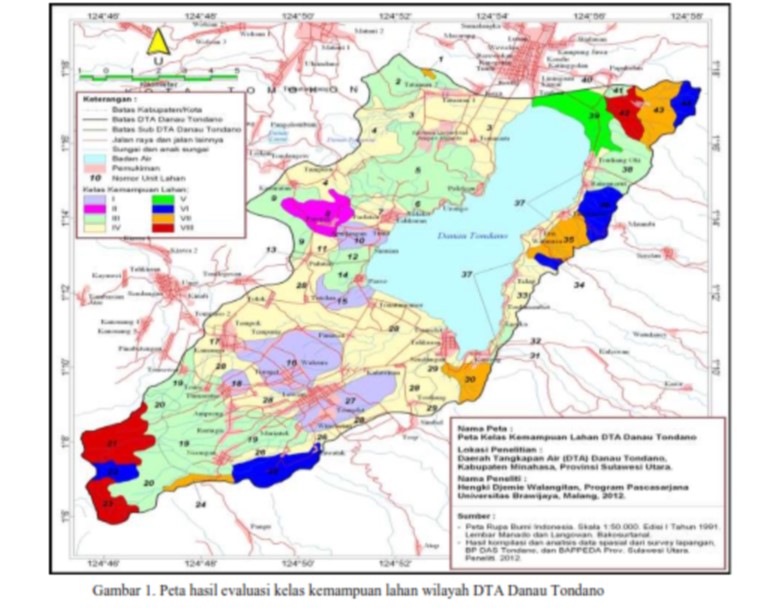
Penelitian ini bertujuan menganalisis dan mengembangkan alternatif rehabilitasi hutan dan lahan (RHL) berdasarkan kemampuan lahan di daerah tangkapan air (DTA) Danau Tondano. Metode evaluasi kemampuan lahan menggunakan pedoman intensitas faktor penghambat yaitu faktor lereng, drainase dan laju infiltrasi dan dianalisis dengan menggunakan Sistem Informasi Geografis (SIG). Sedangkan arahan penggunaan lahan yang ideal pada setiap kemampuan lahan sebagai dasar perencanaan. Hasil analisis spasial diperoleh data luas masing-masing kelas kemampuan lahan sebagai berikut : kelas kemampuan I seluas 2.041,13 ha (11,05 %), lahan kelas II seluas 348,35 ha (1,89 %), lahan kelas III seluas 5.681,27 ha (30,76 %), lahan kelas IV seluas 7.107,37 ha (38,49 %), lahan kelas V
seluas 475,23 ha (2,57 %) lahan kelas VI seluas 957,98 ha ( 5,19 %), lahan kelas VII seluas 1.125,2 ha (6,09%) dan lahan kelas VIII seluas 730,58 ha ( 3,96 %). Berdasarkan hasil evaluasi penggunaan lahan menurut kelampuan lahan saat ini maka dikembangkan arahan RHL sebagai berikut : sekitar 85 % wilayah DTA danau Tondano tergolong dalam kelas kemampuan lahan I sampai kelas V, lahan tersebut dikembangkan sebagai lahan pertanian intensif dengan konservasi tanah pengembangan pertanian organik dalam berbagai variasi implementasi. Selanjutnya sekitar 15 % lainnya dapat dimanfaatkan sebagai kawasan pertanian terbatas dengan tindakan konservasi tanah berupa penyempurnaan sistem agroforestry, pengembangan agroforestry berbasis tanaman cengkih yang tertata atau pengembangan hutan serbaguna pada kawasan hutan lindung dan hutan produksi dengan tanaman penghasil hasil
hutan non kayu (aren, bambu) dan jasa lingkungan.
##submission.copyrightStatement##
##submission.license.cc.by-nc4.footer##Copyright and License
All articles published in Wasian Journal are the property of the authors. By submitting an article to Wasian Journal, authors agree to the following terms:
-
Copyright Ownership: The author(s) retain copyright and full publishing rights without restrictions. Authors grant the journal the right to publish the work first and to distribute it as open access under a Creative Commons Attribution 4.0 International License (CC BY 4.0).
-
Licensing: Articles published in Wasian Journal are licensed under a Creative Commons Attribution 4.0 International License (CC BY 4.0). This license allows others to share, copy, and redistribute the material in any medium or format, and adapt, remix, transform, and build upon the material for any purpose, even commercially, provided that proper credit is given to the original author(s) and the source of the material

This work is licensed under a Creative Commons Attribution 4.0 International License. -
Author's Rights: Authors are permitted and encouraged to post their work online (e.g., in institutional repositories or on their website) prior to and during the submission process, as it can lead to productive exchanges and greater citation of published work.
-
Third-Party Content: If your article contains material (e.g., images, tables, or figures) for which you do not hold copyright, you must obtain permission from the copyright holder to use the material in your article. This permission must include the right for you to grant the journal the rights described above.
-
Reprints and Distribution: Authors have the right to distribute the final published version of their work (e.g., post it to an institutional repository or publish it in a book), provided that the original publication in Wasian Journal is acknowledged.
For the reader you are free to:
- Share — copy and redistribute the material in any medium or format for any purpose, even commercially.
- Adapt — remix, transform, and build upon the material for any purpose, even commercially.
- The licensor cannot revoke these freedoms as long as you follow the license terms.
Under the following terms:
- Attribution — You must give appropriate credit , provide a link to the license, and indicate if changes were made . You may do so in any reasonable manner, but not in any way that suggests the licensor endorses you or your use.
- No additional restrictions — You may not apply legal terms or technological measures that legally restrict others from doing anything the license permits.
Notices:
You do not have to comply with the license for elements of the material in the public domain or where your use is permitted by an applicable exception or limitation .
No warranties are given. The license may not give you all of the permissions necessary for your intended use. For example, other rights such as publicity, privacy, or moral rightsmay limit how you use the material.
相似文章
- Lusiana Pardede, Dian Iswandaru, Yulia Rahma Fitriana, Arief Darmawan, Hari Kaskoyo, Christine Wulandari, Rahmat Safe'I, Susni Herwanti, Novriyanti Novriyanti, Indra Gumay Febryano, Insectivorous Birds Dominate Across Land-Use Gradient Revealing Unexpected Ecological Resilience in Tropical Forest-Coffee Landscapes , Jurnal Wasian: 卷 12 期 01 (2025): June
- I Wayan Sudiyanto, Wahyudi Wahyudi, Assessment and Spatial Mapping of Soil Degradation Status in Bontoharu District, Selayar Islands Regency: A Framework for Sustainable Land Management , Jurnal Wasian: 卷 12 期 01 (2025): June
- Elfrida Kastila Ine Tiga, Lusia Sulo Marimpan, Astin Elise Mau, Nixon Rammang, Assessing Agroforestry Impact on Household Income: A Study of the Bu’u Bei Community Forest (HKm) in Tina Bani Village, Ende, Indonesia , Jurnal Wasian: 卷 11 期 2 (2024): December
- Asikin Muchtar, Nirwana Nirwana, Wahyullah Wahyullah, Mahmud Mahmud, Ummu Kultsum, Analysis of the Success and Vigour of Cashew Seedlings Through Direct Seed Planting (Anacardium occidentale L.) for Sustainable Land Management , Jurnal Wasian: 卷 11 期 2 (2024): December
- Andika Lalu, Sitti Ramlah, Reinaldi Reinaldi, When Strong Institutions Meet Weak Economies: Lessons from Ecotourism Sustainability in Lombuyan Wildlife Sanctuary, Central Sulawesi , Jurnal Wasian: 卷 12 期 02 (2025): December
- Nur Reski, Rahmat Ariandi, Hajawa Hajawa, Hasanuddin Hasanuddin, Sultan Sultan, Andi Azis Abdullah, Gender Roles in Coffee Agroforestry Management: A Case Study of the Boritallasa Community Forestry Area, Gowa Regency, Indonesia , Jurnal Wasian: 卷 13 期 01 (2026): June
- Roslina Yahya Yahya, Hadija Sukri, Nirawati, Ira Nurhayati Djarot Djarot, Responses of Stomatal Characteristics to Environmental Factors in Fabaceae Trees of the Urban Forest in Maros Regency , Jurnal Wasian: 卷 12 期 01 (2025): June
- Muh Faisal Mappiasse, Andi Nurul Mukhlisa , Recognition and Analysis of Pest-Induced Damage in Mangrove Ecosystems: A Case Study in Maros Coastal Region , Jurnal Wasian: 卷 11 期 2 (2024): December
- Rini Pratiwi, Makkarennu Makkarennu, Ridwan Ridwan, Understanding Traditional Walnut Management System in Forest Communities of Selayar Islands, Indonesia , Jurnal Wasian: 卷 12 期 01 (2025): June
- Nisa Nur Ramadhani, Wahyuni Wahyuni, Putri Fatimah Nurdin, Muhammad Daud, Spatiotemporal Land Cover Dynamics and Their Implications For Watershed Quality in the Minraleng Sub-Watershed, Indonesia , Jurnal Wasian: 卷 13 期 01 (2026): June
您也可以开始高级相似性搜索此文章。