1.
Introduction
Land
use is a fundamental component of terrestrial ecosystems that plays
a critical role in sustaining ecological processes and supporting
human livelihoods. However, land use is inherently dynamic and
continuously undergoes changes driven by both natural processes and
anthropogenic activities (Ye
et al., 2024);
(Regasa
et al., 2021).
The conversion of natural vegetation, particularly forests, into
built-up areas, agricultural land, and infrastructure can disrupt
ecosystem balance and accelerate environmental degradation,
including soil erosion, biodiversity loss, and hydrological
alterations (Fauzi
et al., 2016);
(Meli
et al., 2024).
Rapid
population growth and increasing socio-economic demands are widely
recognized as the primary drivers of land use change (Assede
et al., 2023).
Expanding human activities, such as urbanization, agricultural
intensification, and infrastructure development, require substantial
land resources, often leading to the conversion of forests,
grasslands, and wetlands into other land use types. Such
transformations significantly influence watershed hydrology by
increasing surface runoff, reducing infiltration capacity, and
altering natural water flow regimes (Dash
et al., 2024);
(Kunle
et al., 2023);
(Kubangun
et al., 2016).
Land
use change is a complex and dynamic process involving interactions
between human systems and the natural environment, with direct
implications for soil, water, and atmospheric systems (Koomen
et al., 2007).
Similar findings have been reported by Soma
et al. (2023),
who emphasized that land use dynamics strongly influence watershed
quality, particularly through changes in vegetation cover and
hydrological response.
The
Minraleng Sub-Watershed, located in the upstream area of the Walanae
Watershed across Pangkajene, Maros, and Bone Regencies, covers
approximately 50,957.07 ha and plays an important role in
maintaining regional hydrological stability. Despite its ecological
significance, comprehensive studies assessing spatiotemporal land
use dynamics and their implications for watershed quality in this
area remain limited.
Therefore,
this study aims to analyze spatiotemporal land use changes in the
Minraleng Sub-Watershed and evaluate watershed quality based on
permanent vegetation cover using multi-temporal satellite imagery
and GIS-based analysis. The findings are expected to provide
scientific insights to support sustainable watershed management and
land use planning.
2.
Method
1)
Study
Area
Study
Area. This study was conducted over a period of seven months, from
January to July 2024. The research was carried out in the Minraleng
Sub-Watershed, which covers an area of approximately 50,957.07 ha
and is administratively located in Maros Regency, South Sulawesi
Province, Indonesia. The Minraleng Sub-Watershed forms part of the
upstream area of the Walanae Watershed and plays a critical role in
regional hydrological regulation. Spatial data processing and
analysis were conducted at the Watershed Management Laboratory,
Faculty of Forestry, Hasanuddin University. The location of the
study area is presented in Figure 1
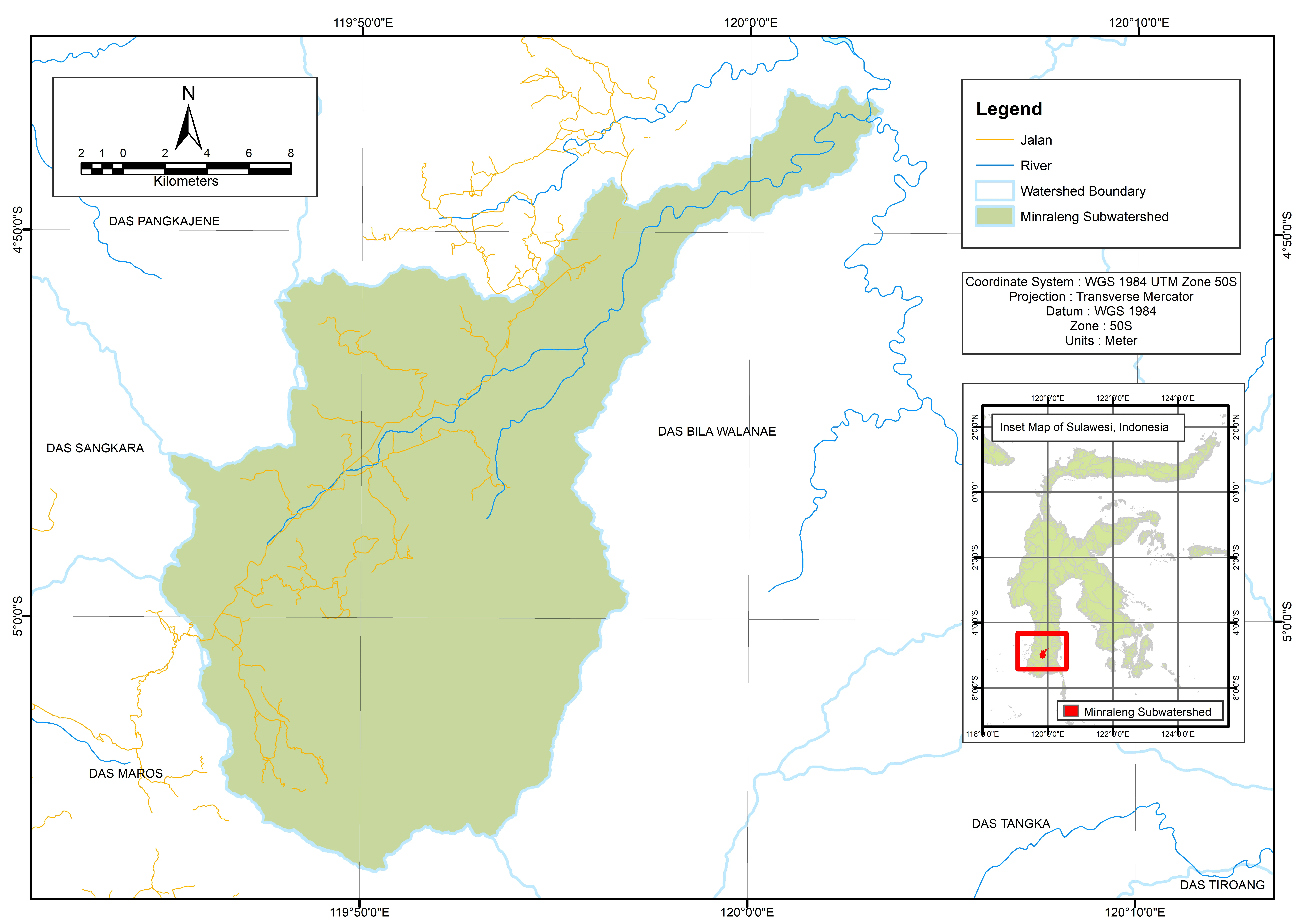
Figure
1.
Map
of the Research Location
2)
Data
and Materials
The
tools used in this study included a laptop, GIS software (Arc Map
10.4), a Global Positioning System (GPS) receiver, a digital camera,
and standard field equipment. The materials consisted of Sentinel-2
Level-2A satellite imagery for the years 2017, 2020, and 2023, as
well as Digital Elevation Model (DEM) data. A three year study
period was adopted to capture the effects of rapid population growth
and the escalating occurrence of flood events in the Minraleng
Sub-Watershed over recent years. The research methodology comprised
several stages, including data preparation, determination of the
study area, data collection, image interpretation through
radiometric correction, band combination, clipping, and on-screen
digitization, field verification, accuracy assessment, and land use
change analysis.
The
data used in this study consisted of primary and secondary data.
Primary data were obtained through field observations and analysis,
including land use information and administrative data of the
Minraleng Sub-Watershed. Secondary data were acquired from existing
sources, including spatial datasets of administrative boundaries.
The data sources are described as follows:
Land
use data were derived from Sentinel-2 Level-2A satellite imagery
for 2017, 2020, and 2023 which was downloaded from
https://scihub.copernicus/ through image interpretation based on
the Indonesian National Standard for land use classification (SNI
7645:2014). Classification accuracy was assessed using a confusion
matrix, including Overall Accuracy (OA) and the Kappa coefficient.
The classification results were considered acceptable when the
overall accuracy exceeded 80% (Julzarika
et al., 2015).
Field verification data were used to validate the classification
results, and the comparison between classified data and ground
observations was summarized in a percentage-based accuracy table.
The
administrative and the road network data obtained from the
Geospatial Information Agency website
(https://tanahair.indonesia.go.id/portal-web/). This information
was employed to facilitate field surveys and observations.
3)
Data
Analysis
Land
use change analysis was conducted using a spatiotemporal overlay
approach by comparing classified land use maps for 2017, 2020, and
2023. This approach enabled the identification and quantification of
transitions between land use classes over time. The results of land
use changes were summarized in tabular form to clearly present the
magnitude and direction of changes. In addition, potential driving
factors and environmental implications of land use change were
qualitatively analyzed.
Watershed
quality is commonly assessed using a range of indicators, including
land criteria. One of the key parameters within the land criterion
is the slassification of permanent vegetative cover, which reflects
the extent and condition of long-term vegetation cover within the
watershed.
The
results of the percentage of vegetation cover, then the data is
organized into categories to assess the quality of the watershed,
following the provisions set out in the Regulation of the Minister
of Forestry of the Republic of Indonesia: P.61/Menhut-II/2014 on
monitoring and evaluation of watershed management.
Table
1. Classes of Percentage of
Vegetation Cover

Nilai
|
Class
|
PVC
> 80%
|
Very
Good
|
60
< PVC ≤ 80 %
|
Good
|
40
< PVC ≤ 60 %
|
Medium
|
20
< PVC ≤ 40 %
|
Bad
|
PVC
≤ 20%
|
Very
Bad
|
The
analysis of permanent vegetation cover focused on land use types
classified as perennial vegetation, including forests, shrubs, and
plantations, as defined in the Regulation of the Minister of
Forestry of the Republic of Indonesia (P.61/Menhut-II/2014). These
vegetation types are characterized by minimal disturbance and are
not subject to regular harvesting. Spatial analysis was performed to
calculate the area of each permanent vegetation class derived from
land use maps. The total area of permanently vegetated land was then
aggregated to estimate the percentage of vegetation cover across the
watershed. The percentage of Permanent Vegetation Cover (PVC) was
calculated using the following equation:
Where:
PVC
= Percentage of Vegetation Cover (%)
LVP
= Area of Permanently Vegetated Land (ha)
Watershed
Area = Targeted watershed area (ha)
3.
Result
and Discussion
1)
Slope
Topographic
conditions in Minraleng Sub-Watershed can be identified by the
category of slope. The slope data was obtained through analysis of
the National DEM (Digital Elevation Model). Classification of slope
and its area distribution can be seen in Table 2.
Table
2. Slope
of the Minraleng Sub-Watershed
Slope
(%)
|
Description
|
Area
(ha)
|
0-8
|
Flat
|
14,131.86
|
8-15
|
Ramps
|
17,914.73
|
15-25
|
Somewhat
Steep
|
12,603.25
|
25-40
|
Steep
|
5,257.41
|
>40
|
Very
steep
|
1,050.58
|
Total
|
50,957.07
|
2)
Land
Use 2017
Based
on image interpretation, the distribution of land use in the
Minraleng Sub-Watershed in 2017 is on the Table 3.
5)
Land
Use Change 2017-2020
Land
use dynamics in the Minraleng Sub-Watershed during the 2017-2020
period exhibited notable fluctuations across several land use
classes, reflecting ongoing land use adjustments driven by local
socio-economic activities. Primary dryland forest experienced a
decline of 482.53 ha (0.95%), which can be attributed to its
conversion into secondary dryland forest due to community activities
in and around forest areas. In contrast, secondary dryland forest
increased by 259.41 ha (0.51%), indicating a process of forest
degradation and transition from primary to secondary vegetation.
Open land showed a reduction of 101.37 ha, primarily due to its
conversion into agricultural land uses, including dryland
agriculture and mixed dryland agriculture. Dryland agriculture
increased slightly by 1.50 ha, while mixed dryland agriculture
expanded more significantly by 167.41 ha (0.33%), largely driven by
the utilization of previously open land and shrub areas for
cultivation. The settlement class decreased marginally by 1.79 ha,
with some areas converted into rice fields. Based on field
observations, several houses were found to be abandoned following
the migration of local residents to other regions for work and
economic reasons.
Meanwhile,
rice fields increased by 29.99 ha (0.45%), indicating a shift toward
irrigated agricultural practices. Shrubland decreased by 72.99 ha
(0.14%), reflecting its conversion into agricultural land,
particularly mixed dryland agriculture and rice fields. Water bodies
exhibited only a minor change, with an increase of 0.37 ha,
suggesting relatively stable hydrological surface conditions during
the study period. Overall, the observed land use changes indicate a
gradual transition from natural and semi-natural vegetation to more
intensive agricultural land uses. This trend may have implications
for watershed functions, particularly in terms of reduced vegetation
cover, increased surface runoff, and a higher risk of soil erosion
and land degradation.
6)
Land
Use Change 2020-2023
Land
use dynamics in the Minraleng Sub-Watershed during the 2020–2023
period showed continued fluctuations, with an overall tendency
toward a decline in productive land uses compared to the 2017–2020
period. These changes reflect ongoing adjustments in land use
practices driven by local socio-economic considerations. Primary
dryland forest decreased by 83.56 ha (0.16%), while secondary
dryland forest declined by 45.19 ha (0.09%). Unlike the previous
period, the reduction in primary forest was not primarily associated
with conversion to secondary forest, but rather to shrubland,
indicating a shift toward less managed or transitional vegetation
types. Open land exhibited only a minor decrease of 3.79 ha (0.01%),
suggesting relatively stable conditions or prior conversion into
other land use classes. Settlement areas decreased by 5.82 ha, with
some areas transitioning into shrubland, reflecting possible land
abandonment or changes in land tenure and utilization. Dryland
agriculture showed a notable decline of 95.75 ha, likely influenced
by changes in farming practices and land use preferences. In some
cases, land was either left fallow, converted to grassland for
livestock, or allowed to revert to shrub vegetation. Similarly,
mixed dryland agriculture decreased by 23.11 ha, indicating reduced
intensity or shifts in land management strategies.
Rice
fields experienced a significant decrease of 176.42 ha, partly due
to conversion into shrubland and water bodies. Meanwhile, shrubland
increased substantially by 420.78 ha, suggesting widespread land
abandonment or reduced agricultural activity. Water bodies also
increased by 12.85 ha, likely associated with the expansion of
irrigation infrastructure or surface water accumulation in low-lying
areas. Overall, the 2020–2023 period is characterized by a
transition from actively managed agricultural land toward more
passive land use types such as shrubland. This trend may indicate
declining land productivity or changing livelihood strategies, with
potential implications for watershed stability, including increased
erosion risk and altered hydrological responses.
7)
Characteristics
of Land Use Change
The
characteristics of land use change in the Minraleng Sub-Watershed
were further analyzed by integrating land use transitions with slope
classes to better understand spatial patterns and associated
environmental risks. During the 2017-2020 period, several
significant land use transitions were observed across different
slope classes. The conversion of primary dryland forest to secondary
dryland forest was most prominent in moderately steep areas,
covering 155.89 ha, indicating forest degradation in ecologically
sensitive zones. Similarly, conversion from primary forest to open
land occurred on steep slopes (2.01 ha), which poses a high risk of
soil erosion and land degradation due to the loss of vegetation
cover. The transition from primary dryland forest to dryland
agriculture (2.36 ha) and rice fields (69.16 ha) was predominantly
observed on gentle slopes, suggesting that these areas are more
suitable for agricultural expansion. However, such changes may alter
hydrological processes if not properly managed.
Secondary
dryland forest conversion to open land (4.33 ha) and agricultural
land, particularly mixed dryland agriculture (60.66 ha) and dryland
agriculture (3.04 ha), was mainly identified on moderately steep
slopes. These transitions increase the vulnerability of land to
erosion and highlight the need for sustainable land management
practices such as agroforestry systems. Shrubland conversion to
mixed dryland agriculture (6.06 ha) also occurred on moderately
steep slopes, further emphasizing the expansion of cultivation into
marginal lands. In the 2020–2023 period, land use transitions
continued to exhibit clear spatial patterns associated with slope.
Secondary dryland forest remained dominant on gentle slopes, with an
area of 77.62 ha, indicating its role in maintaining ecological
stability and carbon sequestration. However, several conversions
from forest to non-forest land uses were observed in steeper areas.
For example, the conversion of primary dryland forest to dryland
agriculture (0.68 ha) and secondary forest to rice fields (2.25 ha)
occurred on moderately steep slopes, which may increase erosion risk
and reduce land suitability for agriculture. A substantial
transition from secondary dryland forest to shrubland was recorded,
covering 160.11 ha on moderately steep slopes. This pattern suggests
land abandonment or degradation processes, where productive land is
no longer actively managed. Notably, several conversions from forest
to non-forest land uses occurred in steep slope areas, including
transitions to open land, agricultural land, shrubland, and water
bodies.
The
largest conversion was from secondary dryland forest to dryland
agriculture, covering 27.15 ha in steep slope areas. Such changes
are environmentally critical, as steep slopes are highly susceptible
to soil erosion, landslides, and hydrological instability. The
conversion of forested land in these areas significantly reduces
slope stability and increases the risk of land degradation. The
integration of land use change and slope analysis highlights that
land conversion is not only driven by socio-economic factors but
also constrained by topographic conditions. The expansion of
agriculture and other land uses into moderately steep and steep
areas indicates increasing pressure on marginal lands.
8)
Land
use Change Analysis
Primary
dryland forest showed a continuous decline over the study period,
decreasing from 15.381,78 ha (2017) to 14.899,25 ha (2020) and
further to 14.815,69 ha (2023). The reduction during 2017–2020 was
primarily associated with conversion to secondary dryland forest,
indicating forest degradation processes. In the 2020–2023 period,
the decline was more closely linked to expansion of shrubland,
suggesting a shift toward less productive or unmanaged land use.
These changes are strongly influenced by anthropogenic pressures,
particularly local dependence on forest resources. Activities such
as small-scale logging and land clearing for subsistence needs
contribute to the gradual degradation of primary forest. Similar
findings have been reported by Dewi
et al. (2023),
highlighting illegal logging as a key driver of forest degradation.
From an ecological perspective, the loss of primary forest reduces
canopy density and structural complexity, which are essential for
regulating hydrological processes. Dense forest vegetation plays a
critical role in enhancing infiltration, reducing surface runoff,
and protecting soil from erosion through canopy interception and
litter layers.
Secondary
dryland forest increased from 13.983,78 ha (2017) to 14.243,25 ha
(2020), reflecting the transition from primary forest. However, it
slightly declined to 14.198.06 ha (2023) due to conversion into
shrubland and agricultural land. The decrease in secondary forest is
primarily driven by agricultural expansion, particularly mixed
dryland agriculture. Socio-economic factors, including population
growth and livelihood dependence on farming, play a major role in
this process (Adamidou
et al., 2026).
Continuous land clearing for agriculture can reduce soil organic
matter, disrupt soil biota, and degrade soil structure, ultimately
lowering infiltration capacity and increasing surface runoff, which
may lead to flooding and landslides (Simanjuntak,
2005).
Open
land decreased significantly from 184.51 ha (2017) to 83.14 ha
(2020) and further to 79.35 ha (2023). This reduction is mainly
attributed to conversion into agricultural land, particularly
dryland and mixed farming systems. Open land in the study area
includes both natural features (e.g., rock outcrops) and
anthropogenically cleared land. The declining trend indicates
increasing land utilization driven by population growth and
infrastructure demands, consistent with findings by Badoa et al.
(2018).
Settlement
areas showed a decreasing trend during both periods, although
population growth continued. This pattern suggests spatial
reorganization of settlements rather than an actual decline in
population. Some settlement areas were converted into agricultural
land or other land use types. Changes in settlement areas have
important hydrological implications. The expansion or redistribution
of built-up areas can reduce infiltration capacity and increase
surface runoff, potentially contributing to flooding within the
watershed. Conversely, when residential areas decrease and are
replaced by vegetative cover, the extend of impervious surfaces is
reduced, resulting in the opposite effect (Purwantara,
2015).
Dryland
agriculture slightly increased from 797.16 ha (2017) to 798.66 ha
(2020), but declined significantly to 702.91 ha (2023). The increase
in the earlier period was driven by conversion from open land, while
the subsequent decline was largely due to conversion into shrubland.
This trend reflects changing agricultural practices and land use
strategies, where some areas are abandoned, left fallow, or
repurposed for livestock grazing. The variability in crop types—such
as maize (Zea
mays),
cassava (Manihot
esculenta),
and chili (Capsicum
annuum)—also
indicates adaptive strategies to seasonal and economic conditions.
Mixed
dryland agriculture expanded from 10,055.86 ha (2017) to 10,223.27
ha (2020), followed by a slight decrease to 10,200.16 ha (2023).
Despite fluctuations, the overall change was relatively stable. This
land use type is dominated by multi-species cropping systems,
including perennial and annual crops such as corn (Zea
mays),
banana (Musa
paradisiaca),
pepper (Paper
nigrum),
coffee (Coffea
arabica),
porang (Amorphophallus
muelleri),
elephant grass (Cenchrus
purpureus),
coconut (Cocus
nucifera),
aren palm (Arenga
pinnata)
and various multipurpose tree species (MPTS) such as cashew
(Anacardium
occidentele),
durian (Durio
zibethinus),
and mango (Mangifera
indica).
The relative stability of this class suggests its importance as a
sustainable land use system that balances productivity and
ecological functions
Rice
fields increased from 7,159.97 ha (2017) to 7,389.97 ha (2020), then
decreased to 7,213.55 ha (2023). The increase was driven by
conversion from open land, while the decline was associated with
conversion into water bodies and other land uses. Changes in rice
field area are closely linked to water availability and irrigation
practices. Expansion of rice fields increases water demand and may
alter watershed hydrology by reducing river discharge due to
increased water retention and evapotranspiration (Amaliah
et al., 2020;
Utari,
2023).
Shrubland decreased from 1,666.85 ha (2017) to 1,593.86 ha (2020)
but increased significantly in 2023 by 2,014.64 ha. This substantial
increase indicates land abandonment or reduced agricultural
activity. Shrubland plays a transitional ecological role by
providing ground cover, reducing runoff, and supporting
biodiversity. However, its expansion at the expense of productive
land may indicate declining land productivity or shifting livelihood
strategies.
Water
bodies increased gradually from 641.76 ha (2017) to 642.13 ha (2020)
and further to 654.98 ha (2023). This increase may be linked to land
clearing and reduced infiltration capacity, resulting in higher
surface water accumulation. Additionally, the expansion of
irrigation systems to support agriculture contributes to the
increase in water bodies. While beneficial for agricultural
productivity, these changes may alter natural hydrological regimes
within the watershed.
9)
Watershed
Quality Based on Permanent Vegetation Cover
Watershed
quality in the Minraleng Sub-Watershed was assessed using the
Permanent Vegetation Cover (PVC) indicator, following the Regulation
of the Minister of Forestry of the Republic of Indonesia
(P.61/Menhut-II/2014). The PVC values were calculated based on the
proportion of land use classified as permanent vegetation, including
primary dryland forest and secondary dryland forest, for the years
2017, 2020, and 2023. The results (Table 6) indicate that the
percentage of permanent vegetation cover remained relatively stable
over the study period, with values of 61% (2017), 60% (2020), and
61% (2023).
Table
6.
Percentage
value of vegetation cover in Minraleng Sub-Watershed
Permanent
Vegetation (Ha)
|
Year
|
Primary
Dryland Forest (Ha)
|
Secondary
Dryland Forest (Ha)
|
Shrubs
(Ha)
|
Permanent
Vegetation Area (Ha)
|
Watershed
Area (Ha)
|
PVC
Value
|
Class
|
2017
|
15,381.78
|
13,983.84
|
1,666.85
|
31,032.47
|
|
0.61
|
GOOD
|
2020
|
14,899.25
|
14,243.25
|
1,593.86
|
30,736.36
|
50,957.07
|
0.6
|
GOOD
|
2023
|
14,815.69
|
14,198.06
|
2,014.64
|
31,028.39
|
|
0.61
|
GOOD
|
A
reduction in permanent vegetation cover can significantly affect
watershed functions, particularly by increasing surface runoff,
reducing infiltration capacity, and elevating the risk of soil
erosion and sedimentation. These findings are consistent with
Pratama
and Yuwono (2016),
who reported that forest conversion alters hydrological
characteristics, including reduced dry-season flow and increased
runoff during the rainy season. A similar conclusion was also
reported by Soma
et al. (2023),
emphasizing that changes in vegetation cover directly influence
watershed hydrological responses. Therefore, maintaining and
restoring permanent vegetation is essential to ensure watershed
sustainability. Strategic efforts such as forest conservation,
reforestation, and sustainable land use management are necessary to
mitigate degradation risks and preserve hydrological functions.
These measures are critical for supporting ecosystem stability and
sustaining the livelihoods of communities dependent on watershed
resources
4.
Conclusion
This
study demonstrates that land use dynamics in the Minraleng
Sub-Watershed are characterized by a gradual transition from primary
dryland forest to secondary vegetation, followed by expansion of
shrubland and agricultural land. The most significant change
occurred during 2017–2020, marked by the conversion of primary
forest into secondary forest, while the 2020–2023 period showed
continued forest decline associated with increasing shrubland.
Despite these changes, watershed quality based on Permanent
Vegetation Cover (PVC) remained relatively stable within the “good”
category, with values ranging from 60% to 61%. However, the observed
reduction in forest cover indicates emerging risks of watershed
degradation, including increased surface runoff, erosion, and
sedimentation. These findings highlight the importance of sustaining
permanent vegetation through conservation and adaptive land
management strategies to maintain hydrological functions and ensure
long-term watershed sustainability under growing anthropogenic
pressure.
5.
Author
Contributions
The
experimental design was devised by Second
author.
Wrote the paper by first
author
and Second
author.
Collected data by Second
author
and third author. Performed analysis by first
author
and third author. The data was interpreted in the result and
discussion by Second
author
and
fourth
author.
6.
Competing
Interests
The
authors are free of conflict of interest.
7.
Acknowledgements
The
authors would like to thank Andi Ratu Gau and Putri Dewitasari for
their help in collecting data and editing the manuscript.
8.
References
Amiruddin,
H. (2025). Surface Erosion and Deposition on Different of Land
Utilization type Bunga Watershed Central Sulawesi Province.
International
Journal of Contemporary Applied Researches,
12(7).
Budi,
S. L., Jondan, B. S., & Ikhsan, J. (2025). Erosi dan Sedimentasi
Akibat Perubahan Tata Guna Lahan pada DAS Winongo Menggunakan Metode
USLE dan Aplikasi Arcgis. Jurnal
Penelitian Pengelolaan Daerah Aliran Sungai,
8(2),
113–130. https://doi.org/10.59465/jppdas.2024.8.2.113-130
Cai,
Z., Wang, J., Yang, Y., & Zhang, R. (2021). Influence of
Vegetation Coverage on Hydraulic Characteristics of Overland Flow.
Water,
13(8),
1055. https://doi.org/10.3390/w13081055
Dharmawan,
I. W. S., Pratiwi, Siregar, C. A., Narendra, B. H., Undaharta, N. K.
E., Sitepu, B. S., Sukmana, A., Wiratmoko, M. D. E., Abywijaya, I.
K., & Sari, N. (2023). Implementation of Soil and Water
Conservation in Indonesia and Its Impacts on Biodiversity,
Hydrology, Soil Erosion and Microclimate. Applied
Sciences,
13(13),
7648. https://doi.org/10.3390/app13137648
Firdazam,
F., Sangkawati, S., & Wulandari, D. A. (2023). Analysis of The
Level of Erosion Hazard in The Walanae Watershed and Land
Conservation Directions to Reduce The Erosion Rate in The Walanae
Watershed. International
Journal of Social Service and Research,
3(12),
3306–3315. https://doi.org/10.46799/ijssr.v3i12.650
Mekonnen,
M. M., & Hoekstra, A. Y. (2020). Sustainability of the blue
water footprint of crops. Advances
in Water Resources,
143,
103679. https://doi.org/10.1016/j.advwatres.2020.103679
Naha,
S., Rico-Ramirez, M. A., & Rosolem, R. (2021). Quantifying the
impacts of land cover change on hydrological responses in the
Mahanadi river basin in India. Hydrology
and Earth System Sciences,
25(12),
6339–6357. https://doi.org/10.5194/hess-25-6339-2021
Neitsch,
S., Arnold, J., Kiniry, J.& Williams J. (2005). Soil and Water
Assessment Tool Theoretical Documentation – Version 2005.
Grassland,
Soil & Water Research Laboratory, Agricultural Research Service,
and Blackland Agricultural Research Station,
Temple, TX, pp. 1–12.
Paiva,
K., Rau, P., Montesinos, C., Lavado-Casimiro, W., Bourrel, L., &
Frappart, F. (2023). Hydrological Response Assessment of Land Cover
Change in a Peruvian Amazonian Basin Impacted by Deforestation Using
the SWAT Model. Remote
Sensing,
15(24),
5774. https://doi.org/10.3390/rs15245774
Pemerintah
Kabupaten Maros (Pemkab). (2021). Profil
Kabupaten Maros 2021.
Peña-Arancibia,
J. L., Bruijnzeel, L. A., Mulligan, M., & van Dijk, A. I. J. M.
(2019). Forests as ‘sponges’ and ‘pumps’: Assessing the
impact of deforestation on dry-season flows across the tropics.
Journal
of Hydrology,
574,
946–963. https://doi.org/10.1016/j.jhydrol.2019.04.064
Suprihati,
R., Hanani, N., Irianto, S. G., & Soemarno, S. (2018). Buffering
capacity of paddy field as the reservoir of rainwater and surface
runoff in the Lowokwaru subdistrict, Malang, East Java. Journal
of Degraded and Mining Lands Management,
5(2),
1065–1076. https://doi.org/10.15243/jdmlm.2018.052.1065
Tajuddin,
Supratman, Salman, D., Yusran, Y., & Sahide, M. A. K. (2018).
Integrated Analysis of Forest Policies and Their Impacts on
Landscape and Lifescape Dynamics: A Case Study in The Walanae Forest
Management Unit, Indonesia. Journal
of Landscape Ecology,
11(3),
155–174. https://doi.org/10.2478/jlecol-2018-0017
Tsuchiya,
R., Kato, T., Jeong, J., & Arnold, J. G. (2018). Development of
SWAT-Paddy for Simulating Lowland Paddy Fields. Sustainability,
10(9),
3246. https://doi.org/10.3390/su10093246
van
Emmerik, T. H. M., Li, Z., Sivapalan, M., Pande, S., Kandasamy, J.,
Savenije, H. H. G., Chanan, A., & Vigneswaran, S. (2014).
Socio-hydrologic modeling to understand and mediate the competition
for water between agriculture development and environmental health:
Murrumbidgee River basin, Australia. Hydrology
and Earth System Sciences,
18(10),
4239–4259. https://doi.org/10.5194/hess-18-4239-2014
W.
Gassman, P., Jeong, J., Boulange, J., Narasimhan, B., Kato, T.,
Somura, H., Watanabe, H., Eguchi, S., Cui, Y., Sakaguchi, A., Hoang
Tu, L., Jiang, R., Kim&Jeffrey G. Arnold, M.-K., & Ouyang,
W. (2022). Simulation of rice paddy systems in SWAT: A review of
previous applications and proposed SWAT+ rice paddy module.
International
Journal of Agricultural and Biological Engineering,
15(1),
1–24. https://doi.org/10.25165/j.ijabe.20221501.7147
Ware,
H. H., Chang, S. W., Lee, J. E., & Chung, I.-M. (2024).
Assessment of Hydrological Responses to Land Use and Land Cover
Changes in Forest-Dominated Watershed Using SWAT Model. Water,
16(4),
528. https://doi.org/10.3390/w16040528
Zhang,
H., Wang, B., Liu, D. L., Zhang, M., Leslie, L. M., & Yu, Q.
(2020). Using an improved SWAT model to simulate hydrological
responses to land use change: A case study of a catchment in
tropical Australia. Journal
of Hydrology,
585,
124822. https://doi.org/10.1016/j.jhydrol.2020.12482
Adamidou,
E., Ioannou, K., Tampakis, S., & Tsantopoulos, G. (2026). A
Scoping Review of Deforestation for Agricultural Expansion over the
Last 25 Years: Farmers’ Motivations. Land, 15(2),
228. https://doi.org/10.3390/land15020228.
Amaliah,
R., Arsyad, U., & Paembonan, S. A. (2020). Effect of land cover
change on stream discharge in Pangkajene watershed, South Sulawesi.
Forest
and Society,
12,
14-23.
Assede,
E.S.P., Orou, H., Biaou, S.S.H. et
al. (2023). Understanding
Drivers of Land Use and Land Cover Change in Africa: A Review. Curr
Landscape Ecol Rep 8,
62–72. https://doi.org/10.1007/s40823-023-00087-w.
Badoa,
M. D., & Kapantow, G. H. (2018). Factors Causing Agricultural
Land Conversion in Tomohon Selatan Sub-district, Tomohon City.
Agri-Socioeconomics,
14(2),
195-204.
Dash,
S. S., Naik, B., & Kashyap, P. S. (2024). Assessment of land
use/ land cover change derived catchment hydrologic response: An
integrated parsimonious hydrological modeling and alteration
analysis based approach. Journal
of Environmental Management,
356(September
2023), 120637. https://doi.org/10.1016/j.jenvman.2024.120637.
Dewi,
R., U., I., Zuhaiery, A., Sa'diyah, N., H., Rizqiya, T., F., &
Nurpratiwi, H. (2023) Harmonizing Community and Government to
Address Deforestation in Southern Tulungagung. Dewantara:
Journal of Social Humanities Education,
2(2), 149-157.
Fauzi
R. M., Joko N. R., and Herawatiningsih. R. (2016). Analysis of Land
Cover Change in Gunung Naning Protected Forest Area, Sekadau
Regency, West Kalimantan Province. Journal
of Sustainable Forest,
4(4), 520-526.
Julzarika,
A., & Carolita, I. (2015). Object-based Land Cover
Classification of SPOT Satellite Image Using Tree Algorithm Method.
Globe
Scientific Magazine,
17(No. 2 December), 97-104.
Koomen,
E., Stillwell, J.C.H., Bakema, A., Scholten, H.J., 2007. Modeling
Land-use change; Progress and Applications, GeoJournal.
Springer.
https://doi.org/10.1007/978-1-4020-5648-2.
https://doi.org/10.1007/978-1-4020-5648-2
Kubangun,
S. H., Haridjaja, O., & Gandasasmita, K. (2016). Land
cover/land use change model for critical land identification in
Bogor District, Cianjur District, and Sukabumi District. Globe
Scientific Magazine,
18(1),
21-32.
Kunle
Babaremu;Taiwo Olalekan; Dickson Ajayi. (2023). Impacts of Land Use
and Land Cover Changes on Hydrological Response. Remote
Sensing of Soil and Land Surface Processes: Monitoring, Mapping, and
Modeling,
19(1),
256–267.
Meli,
P., Ellison, D., Ferraz, S. F. d. B., Filoso, S., & Brancalion,
P. H. S. (2024). On the unique value of forests for water:
Hydrologic impacts of forest disturbances, conversion, and
restoration. Global Change Biology, 30, e17162.
https://doi.org/10.1111/gcb.17162.
Regasa,
M. S., Nones, M., & Adeba, D. (2021). A review on land use and
land cover change in ethiopian basins. Land,
10(6),
1–13. https://doi.org/10.3390/land10060585
.
Regulation
of the Minister of Forestry of the Republic of Indonesia No: P.
61/Menhut-II/2014 on Monitoring and Evaluation of Watershed
Management.
Pratama,
W. and Yuwono, S. B. (2016). Analysis of Land Use Change on
Hydrological Characteristics in Bulok Watershed. Journal
of Sylva Lestari,
4(3): 11-20.
Purwantara,
S. (2015). The impact of settlement development on groundwater in
Yogyakarta and surrounding areas. Geo
Edukasi,
4(1),
31-40.
Simanjuntak.
2005. Performance
Management and Evaluation.
Jakarta: Faculty of Economics, University of Indonesia
Soma,
A. S., Chaeruddin, A. A., and Wahyuni. 2023. Analysis
of the Quality of the Mamasa Sub-Watershed Using the Land Cover
Approach and Land Cover Projections in 2031.
IOP Conference Series: Earth and Environmental Science, 1277:
012023. https://doi.org/10.1088/1755-1315/1277/1/012023
Utari,
N., D. (2023). Changes
in Permanent Vegetation Cover as an Indicator of the Quality of the
Pamukkulu River Watershed.
Hasanuddin University.
Ye,
G., Chen, K., Yang, Y., Liang, S., Hu, W., & He, L. (2024).
Integrative Framework for Decoding Spatial and Temporal Drivers of
Land Use Change in Malaysia: Strategic Insights for Sustainable Land
Management. Land,
13(12).
https://doi.org/10.3390/land13122248.